
 |
 |
 |
 |
 |
 |
 |
 |
 |

 |

Washington DC (SPX) May 12, 2011 The famous Crab Nebula supernova remnant has erupted in an enormous flare five times more powerful than any flare previously seen from the object. On April 12, NASA's Fermi Gamma-ray Space Telescope first detected the outburst, which lasted six days. The nebula is the wreckage of an exploded star that emitted light which reached Earth in the year 1054. It is located 6,500 light-years away in the constellation Taurus. At the heart of an expanding gas cloud lies what is left of the original star's core, a superdense neutron star that spins 30 times a second. With each rotation, the star swings intense beams of radiation toward Earth, creating the pulsed emission characteristic of spinning neutron stars (also known as pulsars). Apart from these pulses, astrophysicists believed the Crab Nebula was a virtually constant source of high-energy radiation. But in January, scientists associated with several orbiting observatories, including NASA's Fermi, Swift and Rossi X-ray Timing Explorer, reported long-term brightness changes at X-ray energies. "The Crab Nebula hosts high-energy variability that we're only now fully appreciating," said Rolf Buehler, a member of the Fermi Large Area Telescope (LAT) team at the Kavli Institute for Particle Astrophysics and Cosmology, a facility jointly located at the Department of Energy's SLAC National Accelerator Laboratory and Stanford University. Since 2009, Fermi and the Italian Space Agency's AGILE satellite have detected several short-lived gamma-ray flares at energies greater than 100 million electron volts (eV) - hundreds of times higher than the nebula's observed X-ray variations. For comparison, visible light has energies between 2 and 3 eV. On April 12, Fermi's LAT, and later AGILE, detected a flare that grew about 30 times more energetic than the nebula's normal gamma-ray output and about five times more powerful than previous outbursts. On April 16, an even brighter flare erupted, but within a couple of days, the unusual activity completely faded out. "These superflares are the most intense outbursts we've seen to date, and they are all extremely puzzling events," said Alice Harding at NASA's Goddard Space Flight Center in Greenbelt, Md. "We think they are caused by sudden rearrangements of the magnetic field not far from the neutron star, but exactly where that's happening remains a mystery." The Crab's high-energy emissions are thought to be the result of physical processes that tap into the neutron star's rapid spin. Theorists generally agree the flares must arise within about one-third of a light-year from the neutron star, but efforts to locate them more precisely have proven unsuccessful so far. Since September 2010, NASA's Chandra X-ray Observatory routinely has monitored the nebula in an effort to identify X-ray emission associated with the outbursts. When Fermi scientists alerted astronomers to the onset of a new flare, Martin Weisskopf and Allyn Tennant at NASA's Marshall Space Flight Center in Huntsville, Ala., triggered a set of pre-planned observations using Chandra. "Thanks to the Fermi alert, we were fortunate that our planned observations actually occurred when the flares were brightest in gamma rays," Weisskopf said. "Despite Chandra's excellent resolution, we detected no obvious changes in the X-ray structures in the nebula and surrounding the pulsar that could be clearly associated with the flare." Scientists think the flares occur as the intense magnetic field near the pulsar undergoes sudden restructuring. Such changes can accelerate particles like electrons to velocities near the speed of light. As these high-speed electrons interact with the magnetic field, they emit gamma rays. To account for the observed emission, scientists say the electrons must have energies 100 times greater than can be achieved in any particle accelerator on Earth. This makes them the highest-energy electrons known to be associated with any cosmic source. Based on the rise and fall of gamma rays during the April outbursts, scientists estimate that the size of the emitting region must be comparable in size to the solar system. NASA's Fermi is an astrophysics and particle physics partnership managed by NASA's Goddard Space Flight Center in Greenbelt, Md., and developed in collaboration with the U.S. Department of Energy, with important contributions from academic institutions and partners in France, Germany, Italy, Japan, Sweden and the United States. The Marshall Space Flight Center manages the Chandra program for NASA's Science Mission Directorate in Washington. The Smithsonian Astrophysical Observatory controls Chandra's science and flight operations from Cambridge, Mass.
Share This Article With Planet Earth
Related Links Fermi Gamma-ray Space Telescope Stellar Chemistry, The Universe And All Within It

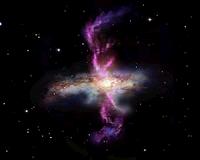 Raging storms sweep away galactic gas
Paris, France (ESA) May 11, 2011 ESA's Herschel infrared space observatory has detected raging winds of molecular gas streaming away from galaxies. Suspected for years, these outflows may have the power to strip galaxies of gas and halt star formation in its tracks. The winds that Herschel has detected are extraordinary. The fastest is blowing at a speed of more than 1000 km/s, or about 10 000 times faster than the wind i ... read more |
|
|
| The content herein, unless otherwise known to be public domain, are Copyright 1995-2010 - SpaceDaily. AFP and UPI Wire Stories are copyright Agence France-Presse and United Press International. ESA Portal Reports are copyright European Space Agency. All NASA sourced material is public domain. Additional copyrights may apply in whole or part to other bona fide parties. Advertising does not imply endorsement,agreement or approval of any opinions, statements or information provided by SpaceDaily on any Web page published or hosted by SpaceDaily. Privacy Statement |


 del.icio.us
 Digg
Digg Reddit
 YahooMyWeb
 Google
 Facebook


