
 |
 |
 |
 |
 |
 |
 |
 |
 |

 |
NASA Engineers Complete Engine Test Series For Ares I Rocket
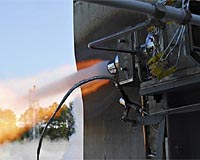
Huntsville AL (SPX) Aug 20, 2008 Engineers at NASA's Marshall Space Flight Center in Huntsville, Ala., have completed a series of tests on a key component of the J-2X engine. The J-2X powers the upper stage of the Ares I rocket, which will launch human explorers to the International Space Station and to the moon. The test on Aug. 15 was the last of 20 in this series, concluding the second of four planned sets of tests on the J-2X's workhorse gas generator, the driver for the turbopumps which start the engine. The gas generator test program is designed to demonstrate the component's performance, durability and combustion environment, and to reduce risk in the design, fabrication and operation of flight hardware. The third phase of testing will begin in July 2009. The J-2X's workhorse gas generator is fabricated by Pratt and Whitney Rocketdyne of Canoga Park, Calif. The primary objectives achieved in this series of tests were to regulate ignition timing and address stability issues in the gas chamber. During engine start, a pressurized helium system begins to turn the turbopumps, which draw liquid hydrogen and liquid oxygen propellants into the system. The propellants flow into the generator's combustion chamber, where they are sparked into life by pyrotechnic igniters installed in the side of the main combustion chamber. Once combustion is initiated, hot gases flow into the turbine. The combustion gas provided by the generator drives the turbomachinery, which delivers high pressure propellants to the main injector during the J-2X burn. This testing allows engineers to address stability issues that can arise during operation of the combustion chamber and will allow engineers to develop a clean design for the J-2X engine. Beginning in 2015, the Ares I rocket will carry the Orion crew capsule and as many as six astronauts and small payloads to the International Space Station. During the first two-and-a-half minutes of flight, the first stage booster will power the vehicle to an altitude of about 189,000 feet, or 36 miles, at a speed of Mach 4.8. After its propellant is spent, the reusable booster will separate, and the upper stage's J-2X engine will ignite -- powering the Orion to low Earth orbit at an altitude of about 425,328 feet, or roughly 80 miles. The workhorse gas generator test series is an essential step in development of the J-2X engine. More than 50 tests have been performed on the generator to date. This generator was manufactured to be more durable than the generators that will be used in the J-2X engine, allowing it to withstand numerous tests. NASA's Johnson Space Center in Houston manages NASA's Constellation Program, which includes development of the Ares I rocket, the Ares V heavy launch vehicle for cargo launcher, the Orion crew capsule, and the Altair lunar lander. Marshall manages Ares projects for the agency. Community Email This Article Comment On This Article Share This Article With Planet Earth
Related Links NASA's Constellation Program Space Tourism, Space Transport and Space Exploration News
 Ohio A Cornerstone Of Space Exploration
 Houston TX (SPX) Aug 20, 2008
The Coalition for Space Exploration, the leading collaboration of space industry businesses and advocacy groups, announced today the release of a statement by Guion "Guy" Bluford, a board member of the Coalition. |
|
|

| The content herein, unless otherwise known to be public domain, are Copyright 1995-2007 - SpaceDaily.AFP and UPI Wire Stories are copyright Agence France-Presse and United Press International. ESA Portal Reports are copyright European Space Agency. All NASA sourced material is public domain. Additional copyrights may apply in whole or part to other bona fide parties. Advertising does not imply endorsement,agreement or approval of any opinions, statements or information provided by SpaceDaily on any Web page published or hosted by SpaceDaily. Privacy Statement |
 del.icio.us
 Digg
Digg Reddit
 YahooMyWeb
 Google
 Facebook