
 |
 |
 |
 |
 |
 |
 |
 |
 |

 |
NASA Develops Highest Resolution Visualization System To Date
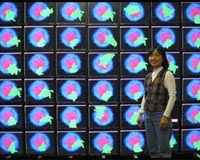
Moffett Field CA (SPX) Jun 26, 2008 The power to visualize highly complex information in a way that's easier for the human mind to grasp is taking a giant leap forward with the advent of NASA's new hyperwall-2 system unveiled at Ames Research Center. Developed by scientists and engineers in the NASA Advanced Supercomputing (NAS) Division at Ames, the 128-screen hyperwall-2, capable of rendering one quarter billion pixel graphics, is the world's highest resolution scientific visualization and data exploration environment. The new tool enables scientists to quickly explore datasets that otherwise would take many years to analyze. The 23-foot-wide by 10-foot tall liquid crystal display wall is being used to view, analyze, and communicate results from NASA's high-fidelity modeling and simulation projects supporting the safety of new space exploration vehicle designs, atmospheric re-entry analysis for the space shuttle, earthquakes, climate change, global weather and black hole collisions. "The hyperwall-2 offers a supercomputer-scale environment that is truly up to the task of visualization and exploration of the very large datasets routinely produced by NASA supercomputers and instruments," said Bryan Biegel, NAS deputy chief. "The system also will be used to get highly detailed information on how NAS supercomputers are operating, enabling staff to quickly and precisely diagnose problems or inefficiencies with the supercomputers or the software running on them." Designed and developed by the NAS visualization team in partnership with Colfax International, Sunnyvale, Calif., the system is powered by 128 graphics processing units and 1,024 processor cores, with 74 teraflops (one teraflop equals one trillion floating point operations per second) of peak processing power and a data storage capacity of 475 terabytes (one terabyte equals one trillion bytes). The hyperwall-2 allows researchers to quickly determine trends across an array of related simulation results, or to view a single large image or animation. It would take nearly 600 video game consoles to equal the hyperwall-2's graphics processing capabilities. "We are proud to continue partnering with NAS as it offers advanced, innovative solutions for high-performance computing," said Gautam Shah, chief executive officer, Colfax International. "As NASA Ames successfully responds to support the visualization and data analysis needs of researchers to maximize the understanding of scientific results, Colfax International is pleased to be part of the hyperwall-2 visualization cluster project," Shah added. Colfax previously built a "mini" hyperwall for NAS used for demonstrations at national conferences. With a direct, high-speed connection from the supercomputers at NAS, including the Columbia supercomputer, hyperwall-2 will enable NASA to meet its increasing needs for advanced visualization and analysis of large, high-dimensional simulation results. With more than 100 times the processing power of the original 49-screen hyperwall developed in 2002 by the NAS visualization team, hyperwall-2 will be integrated with the team's software tools. This includes a state-of-the-art concurrent visualization framework to provide NASA scientists and engineers with ultra-high resolution images and videos to explore results of their research and analysis. Community Email This Article Comment On This Article Share This Article With Planet Earth
Related Links NASA Advanced Supercomputing Super Computer News and HPC Technology
 New Green Supercomputer Powers Up At Purdue
  West Lafayette IN (SPX) Jun 11, 2008
Traditional supercomputers are like huge diesel trucks: They are powerful and can carry a big load. But a new type of supercomputer installed this week at Purdue University, built by SiCortex, is like employing a fleet of thousands of bike messengers: Individually they don't carry much freight, but they use less energy and are more effective in some situations. |
|
|

| The content herein, unless otherwise known to be public domain, are Copyright 1995-2007 - SpaceDaily.AFP and UPI Wire Stories are copyright Agence France-Presse and United Press International. ESA Portal Reports are copyright European Space Agency. All NASA sourced material is public domain. Additional copyrights may apply in whole or part to other bona fide parties. Advertising does not imply endorsement,agreement or approval of any opinions, statements or information provided by SpaceDaily on any Web page published or hosted by SpaceDaily. Privacy Statement |
 del.icio.us
 Digg
Digg Reddit
 YahooMyWeb
 Google
 Facebook