|
 |
 |
 |
 |
 |
 |
 |
 |

 |
NASA Considering Various Hubble Service Options
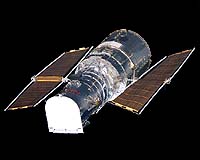
Washington (UPI) April 26,2004 A review of more than two dozen ideas for robotic servicing of the Hubble Space Telescope has identified several promising concepts that may be pursued by NASA before the end of the year, the space agency's space chief scientist told United Press International. "Am I optimistic? Yes. Is it a done deal? No," said Ed Weiler, NASA associate administrator for space science. Weiler said that in response to an agency request for information, 26 proposals have been submitted on ways the telescope could be serviced or de-orbited without the use of human crews. The proposals have come "mostly from commercial companies," Weiler added. NASA had asked for ideas to identify what technologies might be available to use on a Hubble repair mission and what companies might be interested in participating in such an effort. On Jan. 16, NASA Administrator Sean O'Keefe announced that the agency would no longer use the space shuttle fleet to service the telescope's ailing systems due to safety issues. Following the Feb. 1, 2003, shuttle Columbia accident, the board investigating the disaster called for limiting shuttle flights to those where the crew of a damaged craft could take refuge aboard the International Space Station. Such contingencies would arise if a shuttle's crew lacked a specific onboard repair capability or if damages sustained during launch exceeded the crew's capacity to save the spacecraft. A shuttle flight to service Hubble would not be able to fly on to the station in the event it was damaged and would have to rely exclusively on onboard repair capacity. O'Keefe decided that because any Hubble mission would lack the space station refuge option, the increased risk to the crew outweighed the value of the Hubble. Without the shuttle, there appeared to be no other way to conduct the repairs to the telescope, which confronted the astronomy community with the grim possibility the Hubble could die of malfunction years before before a replacement space telescope could be launched. But that possibility has raised such a public outcry that O'Keefe relented slightly on his initial decision and agreed to 1) convene a special inquiry to evaluate the risks of and alternatives to a Hubble repair mission and 2) ask the aerospace industry for ideas on other ways to save, service or de-orbit the craft. The National Academy of Sciences is studying both the decision to cancel the shuttle servicing mission and possible robotic flights to the telescope. Weiler said even before the NAS study -- now set for summer -- is completed, the chances for a robotic rescue will be increasing. Failing a repair mission, he said, NASA is considering sending a robotic craft to take control of the telescope and send it into fiery atmospheric re-entry. The 26 proposals included complete robotic mission scenarios as well as "pieces of missions," Weiler said. In a sense, any rescue or return mission is racing the clock, as Hubble's batteries slowly drain and the craft's critical gyroscopes -- used to aim and hold the telescope in position -- break down. "They can last until the end of '07," Weiler said of the batteries. After that, failure of the power system would send the telescope out of control, making any robotic mission impossible. Even the review by the national academies, due out this summer, might be too late. "We need to be ready to get (a request for proposals) in June," Weiler said. "If we want a robotic mission in '07 or '08, we need to get contracts out this fall." Weiler also said a two-month study of the Hubble issue is underway at the Goddard Spaceflight Center in Greenbelt, Md., as well as five or six other NASA facilities. That in-house review also is looking at robotic systems that could be flown to the telescope, he said. Whatever is decided will be a tradeoff, Weiler suggested, between the cost of such a mission and the value of the years that could be added to Hubble's usefulness. He pointed out that no nation has ever conducted a purely robotic servicing of a spacecraft. Crews aboard space shuttles conducted satellite rescues in 1984 and 1985, and tested a satellite refueling concept in October 1984. But the refueling technique was never used. Use of the shuttle as a servicing system for commercial and civil satellites was canceled following the January 1986 Challenger disaster. Russia has conducted robotic docking of supply craft to the MIR and International Space Station, but cosmonauts and astronauts aboard always have been in final control of the tasks. Japan has tested a small robotic docking spacecraft, but has developed it into an operational system. Thus, if NASA chooses a fully robotic mission to Hubble, it would become another first for U.S. space technology. All rights reserved. Copyright 2004 by United Press International. Sections of the information displayed on this page (dispatches, photographs, logos) are protected by intellectual property rights owned by United Press International. As a consequence, you may not copy, reproduce, modify, transmit, publish, display or in any way commercially exploit any of the content of this section without the prior written consent of by United Press International. Community Email This Article Comment On This Article Related Links SpaceDaily Search SpaceDaily Subscribe To SpaceDaily Express Space Telescope News and Technology at Skynightly.com
 Carl Zeiss And Max Planck Researchers Develop Optical Technology For JWST
 Heidelberg, Germany (SPX) Dec 09, 2005
Carl Zeiss Optronics, in Oberkochen, Germany, and the Max Planck Institute for Astronomy in Heidelberg (MPIA), are developing the main fine mechanical optical technology for two instruments to be part of the James Webb Space Telescope (JWST).
--------------------------------------------------------- It's new. And it's downright terrific! Celestron's CPC Schmidt-Cassegrain telescope is the scope you've been waiting for! It offers new alignment technology, advanced engineering, and bold new design at a new, low price! In fact, Celestron's Professional Computerized (CPC) scope with revolutionary SkyAlign Alignment Technology redefines everything that amateur astronomers are looking for. It offers quick and simple alignment, GPS technology, unsurpassed optical quality, ease of use, advanced ergonomics, enhanced computerization and, most important, affordability. Want to view M-31 tonight? One button takes you there!
Shop for telescopes online at Telescopes.com! today!
|
|
|

| The content herein, unless otherwise known to be public domain, are Copyright 1995-2006 - SpaceDaily.AFP and UPI Wire Stories are copyright Agence France-Presse and United Press International. ESA PortalReports are copyright European Space Agency. All NASA sourced material is public domain. Additionalcopyrights may apply in whole or part to other bona fide parties. Advertising does not imply endorsement,agreement or approval of any opinions, statements or information provided by SpaceDaily on any Web page published or hosted by SpaceDaily. Privacy Statement |