|
 |
 |
 |
 |
 |
 |
 |
 |

 |
NASA Collaborates With Russia On Foton-M3 Mission
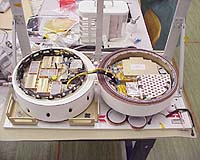
Moffett Field CA (SPX) Sep 12, 2007 NASA is collaborating with Russia on a new robotic mission to conduct biological studies. The Russian Foton-M3 mission is scheduled for launch Sept. 14, 2007, from Kazakhstan, and NASA scientists will participate in several of the mission's experiments. NASA scientists hope the data obtained from the Foton-M3 mission will improve research techniques. The experiments will increase fundamental knowledge of the effects of space on genetics, cell proliferation and tissue regeneration, as well as the physiological effects of microgravity. Scientists will conduct pre-and-post-flight studies in Russia on bacteria, newts, geckos and snails, which will be flown on Foton-M3. As part of the collaboration, U.S. and Russian scientists will exchange all scientific data obtained from the experiments. "A team of U.S. scientists has been invited to participate in the experiments, and our role as co-investigators will be to enhance and expand the science conducted during the mission," explained Michael Skidmore of NASA Ames Research Center, Moffett Field, Calif., who serves as the project manager for the Foton-M3 mission. In addition to scientists from NASA Ames, the team also includes scientists from Montana State University, Bozeman, Mont. Foton-M3 will launch aboard a Russian Soyuz-U rocket. It utilizes a modified Vostok spacecraft, which contains a service module, solid-fuel retro-rocket unit and batteries. The robotic spacecraft will fly in low Earth orbit for 12 days before releasing its reentry module to land in either northern Kazakhstan or southern Russia on Sept. 26, 2007. "NASA's long-term goal is to use simple, easily maintained species to determine the biological responses to the rigors of spaceflight, including the virtual absence of gravity," said Kenneth Souza, also of NASA Ames, who serves as the project scientist. For the Foton-M3 mission experiments, Ames scientists developed eight one-inch-deep aluminum boxes called "attics" to house a small, battery-powered video camera for in-flight video recording, a solid-state video recorder, infrared Light Emitting Diodes and a pump to provide water for the newts and geckos. A timer/processor will control the operations of the attic's components during the experiments. NASA has a long history of cooperative research with the Institute for Biomedical Problems using unpiloted Russian spacecraft starting with the Bion 3 (Cosmos 782) mission in 1975. More recently, NASA participated in the Russian Foton-M2 mission in 2005. "The Foton-M3 data will help validate the results of NASA's Foton-M2 investigations. Fundamental space biology studies, such as those related to Foton-M2 and Foton-M3, advance human knowledge of the effects gravity has had, and continues to have, on all terrestrial life," Skidmore said. Community Email This Article Comment On This Article Related Links NASA Ames Research Center Life Beyond Earth Lands Beyond Beyond - extra solar planets - news and science
 The Protocell Project
 Los Alamos NM (SPX) Sep 11, 2007
At the Los Alamos National Laboratory, scientists are trying to create life. No slimy blobs have yet oozed their way out of a beaker of primordial soup, but scientists are combining some of the most basic elements of life to see if they can make non-living chemistry behave in a life-like way. Cracking the mysterious barrier between life and non-life could give us a clue to how life originated on Earth, and how it might begin elsewhere in the universe. |
|
|

| The content herein, unless otherwise known to be public domain, are Copyright 1995-2007 - SpaceDaily.AFP and UPI Wire Stories are copyright Agence France-Presse and United Press International. ESA Portal Reports are copyright European Space Agency. All NASA sourced material is public domain. Additional copyrights may apply in whole or part to other bona fide parties. Advertising does not imply endorsement,agreement or approval of any opinions, statements or information provided by SpaceDaily on any Web page published or hosted by SpaceDaily. Privacy Statement |