
 |
 |
 |
 |
 |
 |
 |
 |
 |

 |
NASA Coats Main Mirror For Airborne Observatory
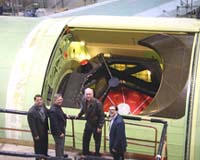
Moffett Field CA (SPX) Jul 03, 2008 The main mirror for NASA's new airborne eye on the universe is now ready for installation after being transformed from a carefully shaped and polished piece of glass into a highly reflective optical component at Ames Research Center. After years of development and preparation, it took just 20 seconds to apply the shiny, aluminum coating to the glass mirror for the Stratospheric Observatory for Infrared Astronomy (SOFIA). The telescope is scheduled to begin observations in mid-2009. "The change was quite sudden and stunning. One moment, we were looking through the transparent glass mirror into its honeycomb-shaped internal structure, and then seconds later, all we saw were reflections," said Patrick Waddell, a systems engineer with the Universities Space Research Association (USRA), which manages the SOFIA science mission for NASA. "There were quite a few technical challenges that caused us to question whether the coating quality would be this good on the first try. We're ecstatic," said Ed Austin, NASA's SOFIA project manager at Ames. Project engineers completed the first mirror coating of the German-built telescope, a major project milestone, in a 10-ton, 16-foot-tall stainless steel vacuum chamber at Ames. SOFIA optical engineers and scientists will annually re-coat the mirror, as is done for other large research telescope mirrors, and also routinely clean the mirror. "The telescope's mirror surface must be highly reflective and clean to ensure the quality of our astronomical observations," said Tom Roellig, SOFIA project scientist. "Keeping the mirror in prime condition ensures that images from space are sharp and precise and that infrared observations are not degraded by heat radiation from dust on the mirror." One of the challenges to a successful coating of the mirror was proper selection and testing of vacuum-compatible materials that support the large structure containing the mirror, known as the mirror cell. According to project scientists, modern telescopes include more of the mirror cell in the coating chamber during the process to simplify telescope disassembly and reassembly. SOFIA is unique because the mirror cell is largely composed of carbon fiber reinforced plastic (CFRP), a material commonly found in tennis racquets and modern sailboat hulls. These types of composite materials provide the light weight and stiffness required for precision airborne optical components, but also easily absorb moisture from the air. The SOFIA Primary Mirror Assembly contains 1,950 pounds of glass and more than 2,400 pounds of CFRP. When the mirror and mirror cell were in the coating chamber and air was removed from the chamber, it took nearly a week for the CFRP to release its absorbed moisture, approximately one pint. After the moisture was removed, the pressure in the coating chamber was low enough for the mirror coating process to begin. The coating chamber vaporizes aluminum by heating more than 60 tungsten filaments around its edges. These filaments have shapes similar to ones found in ordinary light bulbs, but are much larger. Each filament is laced with small twists of 99.999 percent pure aluminum wire. The aluminum coating applied to the mirror glass is only five one-millionths of an inch thick, approximately 1/300 of the thickness of a human hair, and weighs slightly more than 1/14 of an ounce, equivalent to 1/7 of the metal in a soda can. SOFIA is comprised of a heavily modified Boeing 747SP aircraft that will carry a 2.5-meter (98-inch) diameter telescope into the stratosphere to conduct astronomical research, and a ground-based science center. SOFIA is a joint program of NASA and the German Aerospace Agency, Deutsches Zentrum fur Luft- und Raumfahrt (DLR). The SOFIA program is managed by NASA's Dryden Flight Research Center, Edwards, Calif., and the aircraft is based at the NASA Dryden Aircraft Operations Facility, Palmdale, Calif. NASA's Ames Research Center, Moffett Field, Calif., manages the science project. Community Email This Article Comment On This Article Share This Article With Planet Earth
Related Links SOFIA Space Telescope News and Technology at Skynightly.com
 GLAST Mission Operations At NASA Goddard Powered Up
 Greenbelt MD (SPX) Jul 03, 2008
Several bases of operations for NASA's Gamma-ray Large Area Space Telescope (GLAST) are gearing up for data from the recently launched satellite. |
|
|

| The content herein, unless otherwise known to be public domain, are Copyright 1995-2007 - SpaceDaily.AFP and UPI Wire Stories are copyright Agence France-Presse and United Press International. ESA Portal Reports are copyright European Space Agency. All NASA sourced material is public domain. Additional copyrights may apply in whole or part to other bona fide parties. Advertising does not imply endorsement,agreement or approval of any opinions, statements or information provided by SpaceDaily on any Web page published or hosted by SpaceDaily. Privacy Statement |
 del.icio.us
 Digg
Digg Reddit
 YahooMyWeb
 Google
 Facebook