
 |
 |
 |
 |
 |
 |
 |
 |
 |

 |
NASA Awards Contract For Lunar Constellation Spacesuit
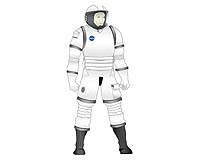
Houston TX (SPX) Jun 13, 2008 NASA has awarded a contract to Oceaneering International, for the design, development and production of a new spacesuit system. The spacesuit will protect astronauts during Constellation Program voyages to the International Space Station and, by 2020, the surface of the moon. The subcontractors to Oceaneering are Air-Lock Inc. of Milford, Conn., David Clark Co. of Worcester, Mass., Cimarron Software Services Inc. of Houston, Harris Corporation of Palm Bay, Fla., Honeywell International Inc. of Glendale, Ariz., Paragon Space Development Corp. of Tucson, Ariz., and United Space Alliance of Houston. "The award of the spacesuit contract completes the spaceflight hardware requirements for the Constellation Program's first human flight in 2015," said Jeff Hanley, Constellation program manager at NASA's Johnson Space Center in Houston. Contracts for the Orion crew capsule and the Ares I rocket were awarded during the past two years. The cost-plus-award-fee spacesuit contract includes a basic performance period from June 2008 to September 2014 that has a value of $183.8 million. During the performance period, Oceaneering and its subcontractors will conduct design, development, test, and evaluation work culminating in the manufacture, assembly, and first flight of the suit components needed for astronauts aboard the Orion crew exploration vehicle. The basic contract also includes initial work on the suit design needed for the lunar surface. "I am excited about the new partnership between NASA and Oceaneering," said Glenn Lutz, project manager for the spacesuit system at Johnson. "Now it is time for our spacesuit team to begin the journey together that ultimately will put new sets of boot prints on the moon." Suits and support systems will be needed for as many as four astronauts on moon voyages and as many as six space station travelers. For short trips to the moon, the suit design will support a week's worth of moon walks. The system also must be designed to support a significant number of moon walks during potential six-month lunar outpost expeditions. In addition, the spacesuit and support systems will provide contingency spacewalk capability and protection against the launch and landing environment, such as spacecraft cabin leaks. Two contract options may be awarded in the future as part of this contract. Option 1 covers completion of design, development, test and evaluation for the moon surface suit components. Option 1 would begin in October 2010 and run through September 2018, under a cost-plus-award fee structure with a total value of $302.1 million. Option 2 provides for the Orion suit production, processing and sustaining engineering under a cost-plus-award fee or a firm-fixed-price, indefinite-delivery, indefinite-quantity contract structure with a maximum value of $260 million depending on hardware requirements. Option 2 would begin at the end of the basic performance period in October 2014, and would continue through September 2018. Community Email This Article Comment On This Article Share This Article With Planet Earth
Related Links the missing link Mars News and Information at MarsDaily.com Lunar Dreams and more
 Scientists Pioneer Method For Making Giant Lunar Telescopes
 Greenbelt MD (SPX) Jun 09, 2008
Scientists working at NASA's Goddard Space Flight Center in Greenbelt, Md., have concocted an innovative recipe for giant telescope mirrors on the Moon. To make a mirror that dwarfs anything on Earth, just take a little bit of carbon, throw in some epoxy, and add lots of lunar dust. |
|
|

| The content herein, unless otherwise known to be public domain, are Copyright 1995-2007 - SpaceDaily.AFP and UPI Wire Stories are copyright Agence France-Presse and United Press International. ESA Portal Reports are copyright European Space Agency. All NASA sourced material is public domain. Additional copyrights may apply in whole or part to other bona fide parties. Advertising does not imply endorsement,agreement or approval of any opinions, statements or information provided by SpaceDaily on any Web page published or hosted by SpaceDaily. Privacy Statement |
 del.icio.us
 Digg
Digg Reddit
 YahooMyWeb
 Google
 Facebook