|
 |
 |
 |
 |
 |
 |
 |
 |

 |
NASA Astrobiologists To Study Extreme Life At Earth's Highest Lake
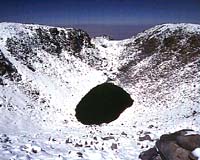
Moffett Field - Oct 11, 2002 Scientists from NASA, the SETI Institute and other organizations are preparing to ascend nearly 4 miles to the summit of a dormant volcano in the Chilean Andes to find out how the organisms that live there can survive in the volcano's hostile environment. During October, the scientists will explore several lakes in the region, including the highest freshwater lake in the world, in the caldera of the Licancabur volcano, almost 20,000 feet high. The information they gather will help astrobiologists devise strategies and technologies to search for life on planets like Mars during future missions. "If there was life on Mars 3.5 billion years ago, it could have used defense mechanisms similar to those used by the organisms at Licancabur volcano to survive," said expedition principal investigator Dr. Nathalie Cabrol of the SETI Institute and NASA Ames Research Center. "This expedition and the follow-up mission in 2003 will provide critical astrobiological information about the limits of life on our planet," Cabrol said. "It also will give us clues about which planets are good candidates to search for life and help in the design of future mission strategies and technologies for exploring ancient martian paleolakes or oceans on Europa." A moon of Jupiter, Europa is believed by some scientists to contain a subsurface ocean of water. Although the lake at Licancabur volcano is covered with almost 2 feet of ice during much of the year, the expedition will take place in the southern hemisphere's spring, when the lake is not completely frozen. The researcher-divers will not use oxygen during their dives, but will have oxygen cylinders onboard a nearby dive boat as a backup precaution. The NASA Ames Safety, Environment and Mission Assurance Directorate has conducted an independent review of the Licancabur mission to ensure safety compliance. The site research will answer three questions critical to astrobiology and space exploration, Cabrol explained;
Another stressor on the life forms at the volcano is low atmospheric pressure, said Cabrol. Because of the volcano's high altitude, the atmospheric pressure is two times lower than at sea level. Researchers also hope to learn how the lake itself survives, given that the volcano is in the Atacama desert, one of the driest places on Earth. The scientists will dive to the lake's bottom to find some of the answers. The researchers theorize that the lake's water temperature may remain warm at the bottom because of heat transferred from the volcano. "Only by going there will we find out," said Cabrol. Research during the 25-day mission, which begins Oct. 16, will include mapping the crater's geology and topography, surveying the depth, topography and temperature of the lake bottom, characterizing the lake's organisms and testing a two-wheeled Mars mini-rover concept. Samples returned from the lake during the mission will be transferred to a support team of scientists who will begin preliminary analysis in the nearby town of Antofagasta. Most samples, however, will be flown to the United States for testing. The team also includes Dr. Chris McKay and Marcus Murbach of NASA Ames, Drs. Imre Friedman, Edmond Grin , Edna DeVore and Roseli Friedman of NASA Ames and the SETI Institute, Drs. Guillermo Chong, Cecilia Demergasso, Lorena Escudero and Cristian Tambley from the Universidad Catolica del Norte in Antofagasta, Chile, David Fike from the Massachusetts Institute of Technology, Andrew Hock from the University of California at Los Angeles, Dr. Keeve Kiss from the Hungarian Academy of Sciences, Dr. Isivan Grigorsky from Kossuth Lajos University in Hungary and Brian Grigsby from the Schreder Planetarium. Community Email This Article Comment On This Article Related Links A Virtual Field Trip To Licancabur Advanced Rural Integrated Science Education NASA Ames Research Center SETI Institute SpaceDaily Search SpaceDaily Subscribe To SpaceDaily Express Life Beyond Earth Lands Beyond Beyond - extra solar planets - news and science
 SETI Sets Its Sights On M Dwarfs
 Moffett Field CA (SPX) Nov 18, 2005
Scientists have been searching actively for signs of intelligent extraterrestrial civilizations for nearly half a century. Their main approach has been to point radio telescopes toward target stars and to "listen" for electronic transmissions from other worlds. |
|
|

| The content herein, unless otherwise known to be public domain, are Copyright 1995-2006 - SpaceDaily.AFP and UPI Wire Stories are copyright Agence France-Presse and United Press International. ESA PortalReports are copyright European Space Agency. All NASA sourced material is public domain. Additionalcopyrights may apply in whole or part to other bona fide parties. Advertising does not imply endorsement,agreement or approval of any opinions, statements or information provided by SpaceDaily on any Web page published or hosted by SpaceDaily. Privacy Statement |