|
 |
 |
 |
 |
 |
 |
 |
 |

 |
NASA Announces Spectacular Day Of The Comet
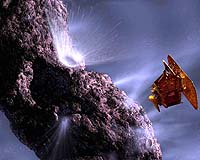
Pasadena CA (SPX) Jun 10, 2005 After a voyage of 173 days and 268 million miles, NASA's Deep Impact spacecraft will get up-close-and-personal with comet Tempel 1 on July 4. The first of its kind, hyper-speed impact between space-borne iceberg and copper-fortified probe is scheduled for approximately 1:52 a.m. EDT on Independence Day. The potentially spectacular collision will be observed by the Deep Impact spacecraft, ground and space-based observatories. "We are really threading the needle with this one," said Rick Grammier, Deep Impact project manager at JPL. "In our quest of a great scientific payoff, we are attempting something never done before at speeds and distances that are truly out of this world." During the early morning hours of July 3, the Deep Impact spacecraft will deploy a 39-inch cubic shaped impactor into the path of the comet, which is about one-half the size of Manhattan Island, N.Y. Over the next 22 hours, Deep Impact navigators and mission members, more than 83 million miles away at JPL, will steer both craft towards the comet. The impactor will steer into the comet and the flyby craft will pass approximately 310 miles below. Tempel 1 is hurtling through space at approximately 6.3 miles per second. At that speed you could travel from New York to Los Angeles in less than 6.5 minutes. Two hours before impact, when mission events will be happening so fast and so far away, the impactor will kick into autonomous navigation mode. It must perform its own navigational solutions and thruster firings to make contact with the comet. "The autonav is like we have a little astronaut on board," Grammier said. "It has to navigate and fire thrusters three times to steer the wine cask-sized impactor into the mountain-sized comet nucleus closing at 23,000 miles per hour." The crater produced by the impact could range in size from a large house up to a football stadium from two to 14 stories deep. Ice and dust debris will be ejected from the crater, revealing the material beneath. The flyby spacecraft has approximately 13 minutes to take images and spectra of the collision and its result before it must endure a potential blizzard of particles from the nucleus of the comet. "The last 24 hours of the impactor's life should provide the most spectacular data in the history of cometary science," said Deep Impact Principal Investigator Dr. Michael A'Hearn of the University of Maryland, College Park. "With the information we receive after the impact, it will be a whole new ballgame. We know so little about the structure of cometary nuclei that almost every moment we expect to learn something new." The Deep Impact spacecraft has four data collectors to observe the effects of the collision. A camera and infrared spectrometer, which comprise the High Resolution Instrument, are carried on the flyby spacecraft, along with a Medium Resolution Instrument. A duplicate of the Medium Resolution Instrument on the impactor will record the vehicle's final moments before it is run over by Tempel 1. "In the world of science, this is the astronomical equivalent of a 767 airliner running into a mosquito," said Don Yeomans, a Deep Impact mission scientist at JPL. "The impact simply will not appreciably modify the comet's orbital path. Comet Tempel 1 poses no threat to the Earth now or in the foreseeable future." Deep Impact will provide a glimpse beneath the surface of a comet, where material from the solar system's formation remains relatively unchanged. Mission scientists expect the project will answer basic questions about the formation of the solar system, by offering a better look at the nature and composition of the frozen celestial travelers we call comets. The University of Maryland is responsible for overall Deep Impact mission management, and project management is handled by JPL. The spacecraft was built for NASA by Ball Aerospace & Technologies Corporation, Boulder, Colo. Community Email This Article Comment On This Article Related Links Deep Impact at NASA SpaceDaily Search SpaceDaily Subscribe To SpaceDaily Express Asteroid and Comet Mission News, Science and Technology
 NASA'S Spitzer Finds Possible Comet Dust Around Dead Star
 Pasadena CA (SPX) Jan 12, 2006
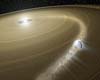
NASA's Spitzer Space Telescope has spotted what may be comet dust sprinkled around the white dwarf star G29-38, which died approximately 500 million years ago. |
|
|

| The content herein, unless otherwise known to be public domain, are Copyright 1995-2006 - SpaceDaily.AFP and UPI Wire Stories are copyright Agence France-Presse and United Press International. ESA PortalReports are copyright European Space Agency. All NASA sourced material is public domain. Additionalcopyrights may apply in whole or part to other bona fide parties. Advertising does not imply endorsement,agreement or approval of any opinions, statements or information provided by SpaceDaily on any Web page published or hosted by SpaceDaily. Privacy Statement |