
 |
 |
 |
 |
 |
 |
 |
 |
 |

 |
NASA And ESA Complete Comparative Exploration Architecture Study
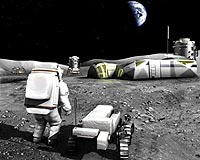
Paris, France (ESA) Jul 10, 2008 Over the last 6 months, representatives from the National Aeronautics and Space Administration (NASA) and the European Space Agency (ESA) have been engaged in detailed assessment of potential programs and technologies that when conducted cooperatively could one day support a human outpost on the Moon. NASA and ESA experts jointly briefed the results of the NASA/ESA Comparative Architecture Assessment on 7 and 8 July during an ESA sponsored Integrated Architecture Review held at ESA's ESTEC facility in Noordwijk, The Netherlands. The study, which commenced in January 2008, was intended to assess the degree to which NASA and ESA's lunar exploration architecture concepts could complement, augment, or enhance the exploration plans of one another. Technical teams from each agency engaged in a series of joint, qualitative assessments of the potential scientific and exploration benefits that arise from collaboration between the ESA capabilities under study and NASA's Ares I and V space transportation systems and lunar surface exploration architecture concepts. NASA is currently studying lunar surface exploration architecture concepts to support humans returning to the Moon before 2020. Consistent with the principles of the Global Exploration Strategy -- a framework for coordinating space exploration plans of 14 participating agencies from around the world --- NASA is pursuing its lunar exploration plans under an "open architecture" approach, which will maximize opportunities for international and commercial participation. NASA's architecture concept calls for the transportation of astronauts and hardware to the moon using the Ares I and Ares V launch vehicles, the Orion crew exploration vehicle, and the Altair lunar lander, which are all currently under development by NASA. ESA is currently studying scenarios and associated architectures for human space exploration, building upon its extensive human space flight experience including its contributions to the International Space Station Programme. While ESA's concept studies are currently at a conceptual stage some of the scenarios assessed as part of this joint study included potential future use of an automated, Ariane 5-based lunar cargo landing system; European developed communication and navigation systems; ESA-developed human rated systems such as an Ariane 5 crew transportation capability and orbital outposts; and ESA-developed dedicated lunar surface elements such as habitation and mobility systems. Findings from the study included a significant mutual interest in the potential development of lunar cargo landing systems, communication and navigation systems, lunar orbital infrastructures, and lunar surface systems such as habitats or mobility systems. The study also identified the significant value to gained from redundant human crew transportation capability. Geoff Yoder, Directorate Integration Office Director of NASA's Exploration Systems Mission Directorate said: "We are very pleased to have worked with ESA on this comparative architecture assessment. Since the announcement of the U.S. Space Exploration Policy, NASA has sought and welcomed input from its international partners on NASA's lunar architecture plans in areas of mutual interest. As future exploration plans mature around the world, , it is becoming increasingly important that we seek compatibilities between NASA's plans and those of its potential future partners. The work we did with ESA will serve as a useful model for discussions with other potential partners as we begin to implement this very exciting mission." Bruno Gardini, ESA Exploration Programme Manager said: "ESA is preparing itself to a round of decisions that will mark Europe's role in human spaceflight and exploration for the decades to come. After the satisfaction of the successful deployment of Columbus and ATV we are looking forward to enhancing our role in the partnership for a sustained and robust space exploration programme where human spaceflight is the cornerstone. The Moon is surely a important case study and an useful test bed to thoroughly prepare for more distant destinations. This architecture work is very useful to prioritise our proposals to European decision-makers and define a European strategy. I would like to thank all the people who have been involved and NASA for their cooperation". Community Email This Article Comment On This Article Share This Article With Planet Earth
Related Links Global Exploration Strategy ESA exploration programme Space Tourism, Space Transport and Space Exploration News
 Secure World Foundation Receives United Nations Permanent Observer Status
 New York NY (SPX) Jul 09, 2008
The Secure World Foundation announced that it has received Permanent Observer status within the United Nations Committee on the Peaceful Uses of Outer Space. |
|
|

| The content herein, unless otherwise known to be public domain, are Copyright 1995-2007 - SpaceDaily.AFP and UPI Wire Stories are copyright Agence France-Presse and United Press International. ESA Portal Reports are copyright European Space Agency. All NASA sourced material is public domain. Additional copyrights may apply in whole or part to other bona fide parties. Advertising does not imply endorsement,agreement or approval of any opinions, statements or information provided by SpaceDaily on any Web page published or hosted by SpaceDaily. Privacy Statement |
 del.icio.us
 Digg
Digg Reddit
 YahooMyWeb
 Google
 Facebook