|
 |
 |
 |
 |
 |
 |
 |
 |

 |
NASA Aims For Mars With Ares Launch Vehicle
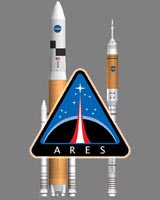
Washington DC (SPX) Jul 10, 2006 NASA has made an important symbolic move with the announcement of the names of the launch vehicles that will be used to send crews and hardware to the Moon and then on to Mars. The Crew Launch Vehicle will be named Ares 1 and the Cargo Launch Vehicle will be called Ares 5. The numerical designations of these vehicles are intended to honor the Saturn launch vehicles of the Apollo program (Saturn 1 & 5). The Ares will use a single five-segment solid rocket booster, a derivative of the space shuttle's solid rocket booster, for the first stage. A liquid oxygen/liquid hydrogen J-2X engine derived from the J-2 engine used on Apollo's second stage will power the crew exploration vehicle's second stage. The Ares I will be able to lift more than 55,000 pounds to low Earth orbit. Ares 5, a true heavy lift launch vehicle, will use five RS-68 liquid oxygen/liquid hydrogen engines mounted below a larger version of the space shuttle's external tank, and two five-segment solid propellant rocket boosters for the first stage. The upper stage will use the same J-2X engine as the Ares 1. The Ares 5 will be able to lift more than 286,000 pounds to low Earth orbit and will stand approximately 360 feet tall. This versatile system will be used to carry cargo and the components into orbit needed to go to the Moon and later to Mars. The selection of the name "Ares" for the boosters is an important symbolic choice concerning the future of the United States space program. "It's appropriate that we named these vehicles Ares, which is a pseudonym for Mars," said Scott Horowitz, associate administrator for NASA's Exploration Systems Mission Directorate. "We honor the past with the number designations and salute the future with a name that resonates with NASA's exploration mission." This name also has a special meaning in the Mars Society because it is the name that Dr. Robert Zubrin and David Baker proposed for a Mars launch vehicle in their 1990 design of the Mars Direct mission. Not only that, but the Ares 5 vehicle planned by NASA is quite similar to the Ares booster design presented by Zubrin and Baker in their Mars Direct plan. The decision to name the boosters "Ares" is thus significant, as it makes a statement that human Mars exploration is truly the objective of NASA. Symbols can be powerful. They define our goals. Hopefully, the selection of "Ares" will help to focus NASA and the nation to what will be one of the greatest achievements in human history, sending humans to Mars. The Mars Society applauds this decision and will continue to do everything in our power to help NASA achieve this great objective. A complete discussion of NASA's plans to send humans to Mars will be presented at the 9th International Mars Society Convention, L'Enfant Plaza Hotel, Washington, DC. Speakers include Mike Griffin and Scott Horowitz. Registration is now open at www.marssociety.org. Community Email This Article Comment On This Article Related Links Mars Society Rocket Science News at Space-Travel.Com
 Successful Test Firing For Vega
 Paris, France (SPX) Jul 10, 2006
ESA's Vega launch vehicle successfully tested its second stage motor, the Zefiro 23, at the Italian Ministry of Defense test center in Salto di Quirra, Sardinia, on June 26. |
|
|

| The content herein, unless otherwise known to be public domain, are Copyright 1995-2006 - SpaceDaily.AFP and UPI Wire Stories are copyright Agence France-Presse and United Press International. ESA PortalReports are copyright European Space Agency. All NASA sourced material is public domain. Additionalcopyrights may apply in whole or part to other bona fide parties. Advertising does not imply endorsement,agreement or approval of any opinions, statements or information provided by SpaceDaily on any Web page published or hosted by SpaceDaily. Privacy Statement |