|
 |
 |
 |
 |
 |
 |
 |
 |

 |
NARVAL The First Observatory Dedicated To Stellar Magnetism
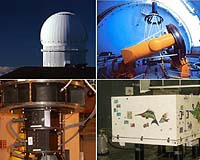
Paris, France (SPX) Feb 13, 2007 NARVAL, a stellar spectropolarimeter, has recently been installed on the 2 meter diameter Bernard Lyot Telescope (INSU-CNRS) at the summit of the Pic du Midi in the French Pyrenees. Like its twin brother, ESPaDOnS, which equips the Canada-France-Hawaii Telescope (INSU-CNRS, National Research Council of Canada, University of Hawaii), it is an astronomical instrument specially designed and optimized to study the magnetic fields of stars and, more specifically, their effects on the life of the stars and the planets that surround them. Thanks to NARVAL, the Bernard Lyot Telescope is now the leading observatory in the world dedicated to this type of study. And, since the Sun sets in Hawaii when it is rising in the Pyrenees, when NARVAL and ESPaDOnS work together they do not miss a single iota of the secrets of the magnetic life of the stars! "Magnetic fields are essential ingredients in the life of stars. They are not only tracers of their history but also play a key role in their evolution" explains Pascal Petit, astronomer at the Laboratoire d'Astrophysique de Toulouse-Tarbes (LATT, Astrophysics Laboratory of Toulouse-Tarbes: CNRS, UPS (Paul Sabatier University), OMP (Pic du Midi Observatory)) and Scientific Director of NARVAL. "It is thought, for example, that the Sun's magnetic field could be at the origin of the Little Ice Age, the period of intense cold that gripped Europe during the reign of Louis XIV (1643-1715). Even more spectacular: magnetic fields are capable of upsetting the birth of stars by modifying the quantity of material from which they form. However, at the moment, relatively little is known of these magnetic fields -- even the Sun's magnetic field remains a mystery to us!" And, according to Michel Auri�re of the LATT, NARVAL project leader "Thanks to NARVAL, we now have a telescope equipped with an instrument dedicated to the study of the magnetic fields of stars. Until now, ESPaDOnS was only available for a small proportion of the time, sharing nights at the Canada-France-Hawaii Telescope with other much sought after instruments. The arrival of NARVAL, a twin copy of ESPaDOnS, will allow French and international astronomers to redouble their efforts and to conduct much more ambitious projects than ever before." David Mouillet, Director of the Bernard Lyot Telescope (TBL) until the end of 2006, adds "Scientists from several countries have not been mistaken in taking the telescope by storm as soon as it was made available to the scientific community!" To demonstrate the power of NARVAL and the important contribution it can make, SU Aurigae, an infant star located 450 light years from the Sun, was continuously scanned both by NARVAL and by ESPaDOnS within the scope of an international collaboration involving the LATT, the Laboratoire d'Astrophysique de Grenoble (LAOG, Astrophysics Laboratory of the Observatory of Grenoble, (CNRS/UJF (Joseph Fourier University)) and several British laboratories. "Only several million years old, SU Aurigae is around 1000 times younger than the Sun" explains Jean-Fran�ois Donati, CNRS Research Director and the designer of ESPaDOnS and NARVAL. "At that age, a star is not yet fully formed and it continues to attract the material that surrounds it. Once captured in the magnetic 'web', the material is then drained towards the star along the field lines, like pearls on a necklace. These observations suggest that SU Aurigae's magnetic 'web' is a lot more complex than was initially predicted by stellar formation models." The NARVAL project is being led by the technical team of the TBL and the LATT. It has benefited from the scientific and technical expertise, unique in the world, which the Toulouse-based research team has built up in the field of astronomic spectropolarimetry over the last decade. Costing a total of around 1 M euro, NARVAL was funded by the Region Midi-Pyrenees (Midi-Pyrenees Region) and the Minist�re de la Recherche (French Ministry of Research) (within the scope of a CPER (French State Region Planning Contract)), the Conseil General des Hautes Pyrenees (Hautes-Pyrenees General Council), the European Union (FEDER funds) and CNRS' Institut National des Sciences de l'Univers (INSU, French National Institute for Sciences of the Universe). The complex network of magnetic field lines emanating from the surface of the infant star SU Aurigae as observed by NARVAL. Community Email This Article Comment On This Article Related Links NARVAL ESPaDOnS Stellar Chemistry, The Universe And All Within It Stellar Chemistry, The Universe And All Within It
 Astrophysicists Explain The Differences In The Brightness Of Supernova Explosions
 Munich, Germany (SPX) Feb 13, 2007
Supernovae stand out in the sky like cosmic lighthouses. Scientists at the Max Planck Institute for Astrophysics and at the National Astronomical Institute of Italy have now found a way to use these cosmic beacons to measure distances in space more accurately. The researchers have been able to show that all supernovae of a certain type explode with the same mass and the same energy - the brightness depends only on how much nickel the supernova contains. |
|
|

| The content herein, unless otherwise known to be public domain, are Copyright 1995-2006 - SpaceDaily.AFP and UPI Wire Stories are copyright Agence France-Presse and United Press International. ESA PortalReports are copyright European Space Agency. All NASA sourced material is public domain. Additionalcopyrights may apply in whole or part to other bona fide parties. Advertising does not imply endorsement,agreement or approval of any opinions, statements or information provided by SpaceDaily on any Web page published or hosted by SpaceDaily. Privacy Statement |