|
 |
 |
 |
 |
 |
 |
 |
 |

 |
Mystery glow traced to 91 space bodies
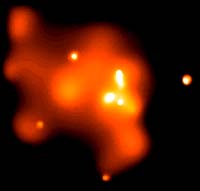
Paris (UPI) March 17, 2004 The European Space Agency's Integral orbiting observatory has traced a mysterious glow at the center of the Milky Way Galaxy to at least 91 heavenly bodies. The unprecedented sensitivity and precision of Integral's telescope IBIS made possible the detection of individual objects buried inside clouds of gas and dust that for the past 30 years have appeared through all other instruments as a puzzling fog. Scientists conducting high-flying balloon-borne experiments discovered the blur of so-called "soft" gamma rays, a form of radiation with energies similar to those emitted in medical X-rays, in the mid-1970s. Francois Lebrun of Yvette, France, and an international team of astronomers describe the source of the rays as 91 clearly defined objects, possibly black holes or the remains of exploded stars energized by celestial swirling dervishes called pulsars, and a host of other less well-defined space entities. The report appears in the journal Nature. INTEGRAL was launched in October 2002 on a Russian Proton rocket. It will now make a complete census of buried black holes in the Milky Way. All rights reserved. Copyright 2004 by United Press International. Sections of the information displayed on this page (dispatches, photographs, logos) are protected by intellectual property rights owned by United Press International. As a consequence, you may not copy, reproduce, modify, transmit, publish, display or in any way commercially exploit any of the content of this section without the prior written consent of by United Press International. Community Email This Article Comment On This Article Related Links SpaceDaily Search SpaceDaily Subscribe To SpaceDaily Express Nuclear Space Technology at Space-Travel.com
 Carina Nebula Dust Pillars Harbor Embedded Stars
 Boulder CO (SPX) May 31, 2005
Astronomers using NASA's Spitzer Space Telescope have imaged a giant molecular cloud being shredded by howling stellar winds and searing radiation, exposing a group of towering dust pillars harboring infant stars, according to a University of Colorado at Boulder researcher. |
|
|

| The content herein, unless otherwise known to be public domain, are Copyright 1995-2006 - SpaceDaily.AFP and UPI Wire Stories are copyright Agence France-Presse and United Press International. ESA PortalReports are copyright European Space Agency. All NASA sourced material is public domain. Additionalcopyrights may apply in whole or part to other bona fide parties. Advertising does not imply endorsement,agreement or approval of any opinions, statements or information provided by SpaceDaily on any Web page published or hosted by SpaceDaily. Privacy Statement |