|
 |
 |
 |
 |
 |
 |
 |
 |

 |
Mystery In A Cup Of Tea
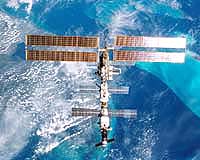
Huntsville - Apr 13, 2004 Try this: In your kitchen at home, squirt a stream of warm honey into a cup of water or tea, and watch what happens. Sweet gooey rivulets, falling downward, twist themselves into curly-cues, filaments, and spinning "smoke rings." It's mesmerizing. But only for a split-second, then the honey splats into the bottom of the cup. Gravity is such a brute. What you need is a kitchen in space. Without gravity dragging everything down, spinning rings of honey in water could hang suspended for hours. Honey-ribbons would have more time to twist and turn, developing into � no one knows what. "How fluids mix in weightlessness is not well understood," explains chemistry professor John Pojman of the University of Southern Mississippi. Here on Earth, he says, the physics is dominated by gravity. Dense fluids sink and light fluids rise; everything else is a side effect of that basic motion. In space, the pull of gravity subsides and other, more subtle phenomena rule. Intermolecular forces can hold films or globs of fluid together that, on Earth, would be torn apart by their own weight. These delicate structures can last for a long time, simply because they float rather than crash into the floor of their container. That's not to say weightless fluids are still. On the contrary, in a container holding two different fluids, like honey and water, scientists expect strange and complicated currents to flow. "Tiny differences in fluid composition or temperature can, in theory, induce stresses that cause convection," explains Pojman. This effect, called "Korteweg stress," is unobservable on Earth because buoyant motions overwhelm it. But in space it could be important. How different is teatime in orbit? Astronaut Don Pettit showed us in 2003 when he filmed himself taking tea onboard the International Space Station (ISS). Instead of sipping from a cup, Pettit used chopsticks to pluck grape-sized blobs of tea from mid-air, grinning each time he popped one in his mouth. Pojman remembers seeing the film. "I wanted to fly right up there and start experimenting," he says. Understanding how fluids behave, singly or in mixtures, is important to the space program, especially now that NASA plans to send people back to the Moon and on to Mars. "We're going to have to manufacture things in space," explains Pojman, "and that means dealing with fluids." As an example, he offers plastics--a key component of habitats, radiation shields, rovers, etc. Plastics are usually formed by combining dissimilar fluids or fluids and powders, then heating the mixture. "If you've ever used BondoTM to repair your car, you've done this yourself: you mix a resin together with peroxide to create a sticky plastic substance," adds Pojman. Mixing is also necessary for certain types of medical space-research--"especially protein crystal growth in microgravity," notes Pojman. When two fluids are put together, do "Korteweg currents" flow? Do the fluids dissolve evenly? Do they break apart into droplets? These details actually make a difference. Pojman himself couldn't go to the ISS to investigate such questions, so he devised an experiment that astronauts could do for him: the Miscible Fluids in Microgravity Experiment or MFMG for short. "MFMG is a very simple experiment," he says. "It involves two syringes, a drinking straw, honey and water. All of these things were already onboard the ISS." One syringe is filled with honey or a honey-water solution, the other with pure water. The tips of the syringes are connected via a short tube (the straw). When all is ready, an astronaut gently squirts a blob of honey into the water, or vice versa, and films what happens. ISS science officer Mike Foale did the experiment last week, and transmitted the video to Earth. "We've already learned something new," says Pojman. There's a number in fluid physics theory called "the square gradient parameter" or k. It's proportional to the strength of intermolecular forces between two different fluids, like honey and water. "How two fluids behave when mixed in low-gravity is going to depend on k," says Pojman. "We've never been able to measure k on Earth for a pair of miscible (mixable) fluids. It's value could be anything! But just from watching the video of MFMG we've got an upper limit on k--it must be less than 10-8 Newtons." He reached this conclusion in the following way: If k were much greater than 10-8 Newtons, honey blobs injected into water would quickly assume a spherical shape. But they didn't. The blobs, squeezed into elongated shapes as they passed through the nozzle of the syringe, remained elongated. "The fact that we could do this using only odds and ends onboard the space station is encouraging," says Pojman. A similar procedure could be used to set limits on, or actually measure, k for many different pairs of fluids. Some fluids are more important than others. Pojman is most interested in monomers and polymers that might be used in space manufacturing. Such fluids are simpler, internally, than honey, so they might lend themselves to "cleaner" measurements of fluid physics constants. It's unlikely, though, than any of those other fluids will be as much fun, or mesmerizing, as honey. Who knows what new physics lies in its sweet spinning "smoke rings" or gooey dancing ribbons? It's something to think about the next time you're relaxing with a cup of tea � and you reach for the honey. Community Email This Article Comment On This Article Related Links Office of Physical and Biological Research SpaceDaily Search SpaceDaily Subscribe To SpaceDaily Express Space Station News at Space-Travel.Com
 NASA Had No Choice But To Buy Soyuz Flights
 Washington DC (SPX) Jan 09, 2006
NASA's announcement last week that it will pay Roskosmos $43.6 million for a round-trip ride to the International Space Station this spring, and an equivalent figure for an as-yet-undetermined number of future flights to the station until 2012, represents the agency's acknowledgment that it had no alternative. |
|
|

| The content herein, unless otherwise known to be public domain, are Copyright 1995-2006 - SpaceDaily.AFP and UPI Wire Stories are copyright Agence France-Presse and United Press International. ESA PortalReports are copyright European Space Agency. All NASA sourced material is public domain. Additionalcopyrights may apply in whole or part to other bona fide parties. Advertising does not imply endorsement,agreement or approval of any opinions, statements or information provided by SpaceDaily on any Web page published or hosted by SpaceDaily. Privacy Statement |