|
 |
 |
 |
 |
 |
 |
 |
 |

 |
Mystery Behind The Strongest Creature In The World
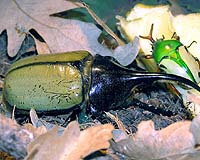
Washington DC (SPX) Mar 12, 2008 The strongest creature in the world, the Hercules Beetle, has a colour-changing trick that scientists have long sought to understand. Research published in the New Journal of Physics details an investigation into the structure of the specie's peculiar protective shell which could aid design of 'intelligent materials'. The Hercules Beetle is remarkable, not only for its strength, able to carry up to 850 times its own weight, the protective outgrowth of the insects' exoskeleton, aka its shell, also changes from green to black as its surrounding atmosphere gets more humid. Researchers from the University of Namur in Belgium have used the latest imaging techniques to study the shell of the beetle - a scanning electronic microscope to determine the structure responsible for the colour and a spectrophotometer to analyze how the light interacts with this structure. The light interferes with the structure to produce the green colour of the shell. When water penetrates through the widely-open porous layers, it destroys the interferences phenomenon leading to a black colouration. The researchers used dry specimen of the beetle's shell to test in laboratory conditions. The beetle, usually found in the rainforests of Columbia, Venezuela, Peru, Ecuador, Bolivia, and Brazil, is still rather mysterious though. As although dry specimen of the shell could be relied on to change when humid conditions were introduced, the living specie that researchers also had in the lab were not as consistent. As to why the beetle changes colour, question marks also remain. Some have suggested that it is to do with protection - it becomes more humid at night and is therefore good for cover to turn black. Others have suggested that it is to do with warmth absorption at night. Questions remain. The techniques used to study the beetle's morphology included new scanning techniques for electron images which over recent years have been refined to yield great depth and therefore help to create three-dimensional images of miniscule structures. Marie Rassart, who did the research at the University of Namur, said, "The sort of structural behaviour displayed by the Hercules Beetle could be an important property for 'intelligent' materials'. Such materials could be put to work as humidity sensors. This could be useful for example in food processing plants to monitor the moisture level." Community Email This Article Comment On This Article Related Links Institute of Physics Darwin Today At TerraDaily.com
 Non-Human Primates Convey Meaning Through Call Combinations
 St Andrews, UK (SPX) Mar 12, 2008
Researchers have made what they say is the first experimental demonstration that a primate other than humans conveys meaning by combining distinct alarm calls in particular ways. The study appears in the March 11th issue of Current Biology, a publication of Cell Press. |
|
|

| The content herein, unless otherwise known to be public domain, are Copyright 1995-2007 - SpaceDaily.AFP and UPI Wire Stories are copyright Agence France-Presse and United Press International. ESA Portal Reports are copyright European Space Agency. All NASA sourced material is public domain. Additional copyrights may apply in whole or part to other bona fide parties. Advertising does not imply endorsement,agreement or approval of any opinions, statements or information provided by SpaceDaily on any Web page published or hosted by SpaceDaily. Privacy Statement |