|
 |
 |
 |
 |
 |
 |
 |
 |

 |
Multipurpose Nanocables Invented
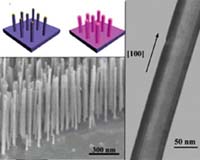
Davis CA (SPX) Nov 17, 2004 Tiny nanocables, 1,000 times smaller than a human hair, could become key parts of toxin detectors, miniaturized solar cells and powerful computer chips. The technique for making the nanocables was invented by UC Davis chemical engineers, led by Pieter Stroeve, professor of chemical engineering and materials science. They manufacture the cables in the nano-sized pores of a template membrane. The insides of the pores are coated with gold. Layers of other semiconductors, such as tellurium, cadmium sulfide or zinc sulfide, are electrochemically deposited in the gold tube until a solid cable forms, then the membrane is dissolved, leaving finished cables behind. Stroeve envisions many uses for these nanocables. For example, the cables' ability to conduct electricity changes when they are exposed to different chemicals or toxins. Earlier nano-devices could only detect whether a toxin was present, said Ruxandra Vidu, a postdoctoral scholar working with Stroeve. But nanocables will go further, measuring the quantity of toxins. Stroeve's team can also construct arrays of nanocables. "You put a copper tape on the tops of the nanocables before the template is dissolved," Stroeve said. "You're left with nanocables sticking up at right angles from the tape." These arrays have a very large surface area - 1000 times greater than on a flat device of the same size. They could be used to efficiently capture sunlight in a tiny solar cell. Nanocables could also be used to make computer chips more powerful by packing transistors closer together. Computers now contain silicon chips with metal transistors affixed to the surface. "With our new technique, we could embed transistors into the silicon chips to begin with," Stroeve said. The work is published online in the Journal of the American Chemical Society. Community Email This Article Comment On This Article Related Links UC Davis SpaceDaily Search SpaceDaily Subscribe To SpaceDaily Express Nano Technology News From SpaceMart.com Computer Chip Architecture, Technology and Manufacture
 Prof Develops Cancer Nanobomb
 Newark DE (SPX) Oct 14, 2005
University of Delaware researchers are opening a new front in the war on cancer, bringing to bear new nanotechnologies for cancer detection and treatment and introducing a unique nanobomb that can literally blow up breast cancer tumors. |
|
|

| The content herein, unless otherwise known to be public domain, are Copyright 1995-2006 - SpaceDaily.AFP and UPI Wire Stories are copyright Agence France-Presse and United Press International. ESA PortalReports are copyright European Space Agency. All NASA sourced material is public domain. Additionalcopyrights may apply in whole or part to other bona fide parties. Advertising does not imply endorsement,agreement or approval of any opinions, statements or information provided by SpaceDaily on any Web page published or hosted by SpaceDaily. Privacy Statement |