|
 |
 |
 |
 |
 |
 |
 |
 |

 |
Multiple Planets Makes For Magical Pre Dawn Sky
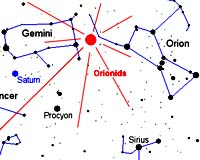
Huntsville AL (SPX) Oct 21, 2004 Would you like to see a piece of Halley's Comet streak past a planet that looks like an exploding star? No problem. Just set your alarm. It's going to happen, in plain view - no telescope required, on Thursday morning, Oct. 21st. Go outside before sunrise, around 5:30 a.m. is best, and look east. The brightest object in that direction is the planet Venus. It looks like a star going supernova. Above Venus lies Saturn, and below, near the horizon, is Jupiter. Every 10 minutes or so you'll see a meteor streak among these planets. The meteors are pieces of Halley's Comet. "Every year around this time Earth glides through a cloud of dusty debris from Halley's Comet," explains Bill Cooke of the NASA Marshall Space Flight Center. "Bits of dust, most no larger than grains of sand, disintegrate in Earth's atmosphere and become shooting stars." "It's not an intense shower," he says, "but it is a pretty one." Astronomers call it the "Orionid meteor shower," because the meteors appear to stream out of a point (called "the radiant") in the constellation Orion. The radiant is near Orion's left shoulder. But don't stare at that spot, advises Cooke. Meteors near the radiant seem short and stubby, a result of foreshortening. Instead, look toward any dark region of the sky about 90 degrees away. The vicinity of Venus or Jupiter is good. You'll see just as many Orionids there, but they will seem longer and more dramatic. Framing the scene are several bright stars: Sirius, Regulus, Procyon and others. Pay special attention to Castor and Pollux in Gemini. They're arranged in an eye-catching line with Saturn. To sum it up in one word: "sparkling." Two more words: "early" and "cold." Or how about "worth waking up for?" You decide.
More about the Orionids The Orionids are related to the eta Aquarids, a southern hemisphere meteor shower in May. Both spring from Halley's Comet. "Earth comes close to the orbit of Halley's Comet twice a year, once in May and again in October," explains Don Yeomans, manager of NASA's Near-Earth Object Program at the Jet Propulsion Laboratory. Although the comet itself is rarely nearby - it's near the orbit of Neptune now - Halley's dusty debris constantly moves through the inner solar system and causes the two regular meteor showers. In 1986, the last time Comet Halley swung past the Sun, solar heating evaporated about 6 meters of dust-laden ice from the comet's nucleus. That's typical, say researchers. The comet has been visiting the inner solar system every 76 years for millennia, shedding layers of dust each time. At first, the bits of dust simply follow the comet, which means they can't strike our planet. Earth's orbit and Halley's orbit, at their closest points, are separated by 22 million km (0.15 AU). Eventually, though, the dust spreads out and some of it migrates until it is on a collision course with Earth. "Particles that leave the nucleus evolve away from the orbit of the comet for two main reasons," explains Yeomans. "First, gravitational perturbations caused by encounters with planets are different [for the dust and for the comet]. Second, dust particles are affected by solar radiation pressure to a far greater extent than the comet itself." "The orbital evolution of Halley's dust is a very complicated problem," notes Cooke. No one knows exactly how long it takes for a dust-sized piece of Halley to move to an Earth-crossing orbit - perhaps centuries or even thousands of years. One thing is certain: "Orionid meteoroids are old." They're also fast. "Orionid meteoroids strike Earth's atmosphere traveling 66 km/s or 148,000 mph," he continued. Only the November Leonids (72 km/s) are faster. Sometimes fast meteors explode, and they leave glowing "trains" (incandescent bits of debris in their wake) that last for several seconds to minutes. These trains, blown by upper atmospheric winds into twisted and convoluted shapes, can be even prettier than the meteors themselves. You never know what you might see, before sunrise, on a magical Thursday morning. Community Email This Article Comment On This Article Related Links SpaceDaily Search SpaceDaily Subscribe To SpaceDaily Express Asteroid and Comet Mission News, Science and Technology
 NASA'S Spitzer Finds Possible Comet Dust Around Dead Star
 Pasadena CA (SPX) Jan 12, 2006
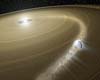
NASA's Spitzer Space Telescope has spotted what may be comet dust sprinkled around the white dwarf star G29-38, which died approximately 500 million years ago.
--------------------------------------------------------- It's new. And it's downright terrific! Celestron's CPC Schmidt-Cassegrain telescope is the scope you've been waiting for! It offers new alignment technology, advanced engineering, and bold new design at a new, low price! In fact, Celestron's Professional Computerized (CPC) scope with revolutionary SkyAlign Alignment Technology redefines everything that amateur astronomers are looking for. It offers quick and simple alignment, GPS technology, unsurpassed optical quality, ease of use, advanced ergonomics, enhanced computerization and, most important, affordability. Want to view M-31 tonight? One button takes you there!
Shop for telescopes online at Telescopes.com! today!
|
|
|

| The content herein, unless otherwise known to be public domain, are Copyright 1995-2006 - SpaceDaily.AFP and UPI Wire Stories are copyright Agence France-Presse and United Press International. ESA PortalReports are copyright European Space Agency. All NASA sourced material is public domain. Additionalcopyrights may apply in whole or part to other bona fide parties. Advertising does not imply endorsement,agreement or approval of any opinions, statements or information provided by SpaceDaily on any Web page published or hosted by SpaceDaily. Privacy Statement |