|
 |
 |
 |
 |
 |
 |
 |
 |

 |
Multi-Generational Space Science Missions
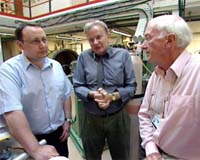
Paris (ESA) Jul 05, 2004 The Cassini-Huygens mission has taken more than six-and-a-half years to reach its destination, and scientists have been working on its instruments since the late eighties. But this isn't the first nor the last multi-generational mission that ESA has undertaken. When ESA's comet chaser started its journey last March, all its scientific investigators knew they would have to wait 10 years before Rosetta obtained its first data. Space science exploration often requires a long-term view and much patience. Scientists have to ensure the continuity of their research by encouraging younger colleagues. One of the many research centres participating in such long-term ESA missions is the Open University's Planetary and Space Sciences Research Institute, at Milton Keynes near London. Tony McDonnell, aged 65 , is an authority on cosmic dust. One of his instruments was on the Giotto probe when it flew past comet Halley in March 1986. A younger member of that Giotto team was John Zarnecki, 54 , who today is now waiting for data from ESA's Huygens mission and from Rosetta. Zarnecki has in turn prepared other colleagues, including 38 year-old Neil McBride, to continue this long-term research. "We are not just scientists, but also involved in education, in the process of passing on information," explains Tony McDonnell. "Even research students have to get used to the fact that experiments they design will produce data for others." Neil McBride confirms this. "I arrived when Giotto flew past its second comet in 1992. I was working then with an experiment that had been conceived 15 years earlier. One must have a long-term view." "When I started working on Rosetta, I realised that there was a strong possibility that I wouldn't benefit personally from the fruits of my work," says Zarnecki. "I must say that I at first found this difficult to come to terms with. But when one reaches a certain age, or a certain maturity, you come to accept that it's for future generations." The multi-generational aspect of such missions is accentuated by the phenomenal quantities of data that are collected. Investigators with instruments on the Cassini-Huygens mission recognise that information to be sent back on Saturn and its largest moon Titan will keep scientists occupied for ten, perhaps even twenty years... whilst they are still learning things from the data obtained by the Voyager probes which just flew past the ringed planet in the early 80s. Community Email This Article Comment On This Article Related Links SpaceDaily Search SpaceDaily Subscribe To SpaceDaily Express Explore The Ring World of Saturn and her moons Jupiter and its Moons The million outer planets of a star called Sol News Flash at Mercury
 Cassini Images Halo Around Titanic Moon Off Saturn
 Pasadena CA (SPX) Dec 27, 2005
With its thick, distended atmosphere, Titan's orange globe shines softly, encircled by a thin halo of purple light-scattering haze. |
|
|

| The content herein, unless otherwise known to be public domain, are Copyright 1995-2006 - SpaceDaily.AFP and UPI Wire Stories are copyright Agence France-Presse and United Press International. ESA PortalReports are copyright European Space Agency. All NASA sourced material is public domain. Additionalcopyrights may apply in whole or part to other bona fide parties. Advertising does not imply endorsement,agreement or approval of any opinions, statements or information provided by SpaceDaily on any Web page published or hosted by SpaceDaily. Privacy Statement |