|
 |
 |
 |
 |
 |
 |
 |
 |

 |
Movie Shows Hydrocarbon Haze Huygens Will Encounter During Titan Entry
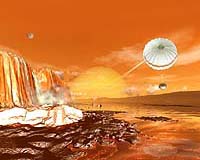
Berkeley - Apr 16, 2004 As the Cassini-Huygens spacecraft approaches a July encounter with Saturn and its moon Titan, a team of University of California, Berkeley, astronomers has produced a detailed look at the moon's cloud cover and what the Huygens probe will see as it dives through the atmosphere of Titan to land on the surface. Astronomer Imke de Pater and her UC Berkeley colleagues used adaptive optics on the Keck Telescope in Hawaii to image the hydrocarbon haze that envelops the moon, taking snapshots at various altitudes from 150-200 kilometers down to the surface. They assembled the pictures into a movie that shows what Huygens will encounter when it descends to the surface in January 2005, six months after the Cassini spacecraft enters orbit around Saturn. "Before, we could see each component of the haze but didn't know where exactly it was in the stratosphere or the troposphere. These are the first detailed pictures of the distribution of haze with altitude," said atmospheric chemist Mate Adamkovics, a graduate student in UC Berkeley's College of Chemistry. "It's the difference between an X-ray of the atmosphere and an MRI." "This shows what can be done with the new instruments on the Keck Telescope," added de Pater, referring to the Near Infrared Spectrometer (NIRSPEC) mounted with the adaptive optics system. "This is the first time a movie has been made, which can help us understand the meteorology on Titan." Adamkovics and de Pater note than even after Cassini reaches Saturn this year, ground-based observations can provide important information on how Titan's atmosphere changes with time, and how circulation couples with the atmospheric chemistry to create aerosols in Titan's atmosphere. This will become even easier next year when OSIRIS (OH-Suppressing Infra-Red Imaging Spectrograph) comes on-line at the Keck telescopes, de Pater said. OSIRIS is a near-infrared integral field spectrograph designed for the Keck's adaptive optics system that can sample a small rectangular patch of sky, unlike NIRSPEC, which samples a slit and must scan a patch of sky. De Pater presented the results and the movie on Thursday, April 15, at an international conference in The Netherlands on the occasion of the 375th birthday of the Dutch scientist Christiaan Huygens. Huygens was the first "scientific director" of the Acad=E9mie Fran=E7aise and the discoverer of Titan, Saturn's largest moon, in 1655. The four-day conference, which started April 13, is taking place at the European Space & Technology Centre in Noordwijk. The movie can be viewed at http://astron.berkeley.edu/~madamkov/titan/. The Cassini-Huygens mission is an international collaboration between three space agencies - the National Aeronautics and Space Administration, the European Space Agency and the Italian Space agency - involving contributions from 17 nations. It was launched from Kennedy Space Center on Oct. 15, 1997. The spacecraft will arrive at Saturn in July, with the Cassini orbiter expected to send back data on the planet and its moons for at least four years. The orbiter also will relay data from the Huygens probe as it plunges through Titan's atmosphere and after it lands on the surface next year. What makes Titan so interesting is its seeming resemblance to a young Earth, an age when life presumably arose and before oxygen changed our planet's chemistry. The atmospheres of both Titan and the early Earth were dominated by nearly the same amount of nitrogen. The atmosphere of Titan has a significant amount of methane gas, which is chemically altered by ultraviolet light in the upper atmosphere, or stratosphere, to form long-chain hydrocarbons, which condense into particulates that create a dense haze. These hydrocarbons, which could be like oil or gasoline, eventually settle to the surface. Radar observations indicate flat areas on the moon's surface that could be pools or lakes of propane or butane, Adamkovics said. Astronomers have been able to pierce the hydrocarbon haze to look at the surface using ground-based telescopes with adaptive optics or speckle interferometry, and with the Hubble Space Telescope, always with filters that allow the telescopes to see through "windows" in the haze where methane doesn't absorb. Imaging the haze itself hasn't been as easy, primarily because people have had to observe at different wavelengths to see it at specific altitudes. "Until now, what we knew about the distribution of haze came from separate groups using different techniques, different filters," Adamkovics said. "We get all that in one go: the 3-D distribution of haze on Titan, how much at each place on the planet and how high in the atmosphere, in one observation." The NIRSPEC instrument on the Keck telescope measures the intensity of a band of near-infrared wavelengths at once as it scans about 10 slices along Titan's surface. This technique allows reconstruction of haze versus altitude because specific wavelengths must come from specific altitudes or they wouldn't be visible at all because of absorption. The movie Adamkovics and de Pater put together shows a haze distribution similar to what had been observed before, but more complete and assembled in a more user-friendly way. For example, haze in the atmosphere over the South Pole is very evident, at an altitude of between 30 and 50 kilometers. This haze is known to form seasonally and dissipate during the Titan "year," which is about 29 1/2 Earth years. Stratospheric haze at about 150 kilometers is visible over a large area in the northern hemisphere but not the southern hemisphere, an asymmetry observed previously. At the southern hemisphere's tropopause, the border between the lower atmosphere and the stratosphere at about 42 kilometers altitude, cirrus haze is visible, analogous to cirrus haze on Earth. The observations were made on Feb. 19, 20 and 22, 2001, by de Pater and colleague Henry G. Roe of the California Institute of Technology, and analyzed by Adamkovics using models made by Caitlin A. Griffith of the University of Arizona, with co-author S. G. Gibbard of Lawrence Livermore National Laboratory. The work was sponsored in part by the National Science Foundation and the Technology Center for Adaptive Optics. MOVIE URL is http://astron.berkeley.edu/~madamkov/titan/. CommunityEmail This Article Comment On This Article Related Links Saturn At JPL SpaceDaily Search SpaceDaily Subscribe To SpaceDaily Express Explore The Ring World of Saturn and her moons Jupiter and its Moons The million outer planets of a star called Sol News Flash at Mercury
 Titan's Methane Mystery
 Moffett Field CA (SPX) Dec 12, 2005
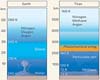
The methane giving an orange hue to Saturn's giant moon Titan likely comes from geologic processes in its interior according to measurements from the Gas Chromatograph Mass Spectrometer (GCMS), a Goddard Space Flight Center instrument aboard the European Space Agency's Huygens Probe. |
|
|

| The content herein, unless otherwise known to be public domain, are Copyright 1995-2006 - SpaceDaily.AFP and UPI Wire Stories are copyright Agence France-Presse and United Press International. ESA PortalReports are copyright European Space Agency. All NASA sourced material is public domain. Additionalcopyrights may apply in whole or part to other bona fide parties. Advertising does not imply endorsement,agreement or approval of any opinions, statements or information provided by SpaceDaily on any Web page published or hosted by SpaceDaily. Privacy Statement |