|
 |
 |
 |
 |
 |
 |
 |
 |

 |
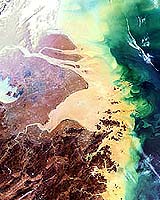
Mouth of the mighty Yangtze
Paris - Mar 26, 2004 The coloured waters shown here in this 21 March Envisat Medium Resolution Imaging Spectrometer (MERIS) image have concluded a long journey across China. They are surging into the East China Sea from the mouth of the Yangtze River, which at 6300 km long is the longest river in Asia and the third longest in the world. Rising in the Qinghai-Tibetan Plateau, the Yangtze River snakes through nine provinces and serves as a drain for 1.8 million square kilometres of territory. MERIS is designed to detect ocean colour, and clearly visible here is how the Yangtze's heavy sediment plume discharges into and colours the waters along the Chinese coast. Its total sediment load is estimated at 680 million tonnes a year � equivalent in weight to a hundred Great Pyramids. Shanghai - China's largest city - is located south of the Yangtze mouth and the 1000-km-long navigable stretch of the Yangtze west of it is a zone of major economic activity. The downside of recent growth has been a decrease in water quality that the Chinese government say it intends to combat. At the start of the month an accidental chemical spill into a tributary of the Yangtze temporarily deprived almost a million people of drinking water. Community Email This Article Comment On This Article Related Links Envisat SpaceDaily Search SpaceDaily Subscribe To SpaceDaily Express Earth Observation News - Suppiliers, Technology and Application
 New Legislation Initiated To Support Commercial Remote Sensing Industry
 New York NY (SPX) Jan 11, 2006
The importance of remotely sensed data and technologies to support natural disasters has prompted attention and action in Washington. New initiatives and legislation authorizing appropriations to the remote sensing industry will be discussed at Strategic Research Institute's U.S. Commercial Remote Sensing Industry conference, scheduled for February 9-10, 2006 in Washington D.C. |
|
|

| The content herein, unless otherwise known to be public domain, are Copyright 1995-2006 - SpaceDaily.AFP and UPI Wire Stories are copyright Agence France-Presse and United Press International. ESA PortalReports are copyright European Space Agency. All NASA sourced material is public domain. Additionalcopyrights may apply in whole or part to other bona fide parties. Advertising does not imply endorsement,agreement or approval of any opinions, statements or information provided by SpaceDaily on any Web page published or hosted by SpaceDaily. Privacy Statement |