|
 |
 |
 |
 |
 |
 |
 |
 |

 |
Mount Stromlo Begins Rising
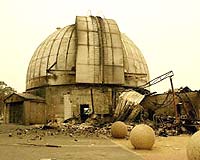
Canberra - Jan 24, 2003 Earlier this week, Australia's well-known Mount Stromlo observatory was devastated by bushfires. The loss of the observatory's telescope domes and several other buildings has halted astronomical observations at the site, and placed other activities on hold. The observatory's research and general staff are proving hard to contact at the present, as they struggle with poor communications links and the need to relocate. Anecdotal reports suggest that staff will probably not be able to move back to any remaining offices on the site for several weeks. But just days after the fire, Mount Stromlo has already begun to rise from the ashes. Computer servers have been salvaged from the site and are being relocated to another campus of the Australian National University, the academy that operates the observatory. The University's Web site has announced that an astronomy summer school, scheduled for later this (southern hemisphere) summer, will proceed as planned. Students in astrophysics are being advised to enrol in a "business as usual" style. The Observatory is also beginning to attract support and practical help. "Everyone in Australia is pretty shocked and we are offering any assistance that we can", says Associate Professor Michael Ashley from the University of New South Wales. "Many of us have worked there as students or research staff. We're very fond of it. It's crucial that it's rebuilt as rapidly as possible." The response from international astronomers has been no less sympathetic. "The astrophysical community is pretty close knit. Everyone knows everyone else in their area of speciality", adds Ashley. Professor Penny Sackett, Director of the Research School of Astronomy and Astrophysics at the Australian National University, told SpaceDaily that preparations for continuing operations by staff had begun the day after the fire. Some are already back at work in temporary offices, but others have not been so fortunate. Some Mount Stromlo personnel also lost their homes in the fires, or are engaged in fire-fighting activities. Although no formal research work is taking place on the mountain, Sackett stated that safety and insurance assessors have visited the site and repairs are being made. Power has been restored through the use of emergency generators and the water supply was being reconnected. Glass on some of the surviving buildings that had been damaged would be replaced very soon. But restoring communications links to Mount Stromlo would take longer, as new cables would need to be installed. Some workshops and facilities used to manufacture astronomical hardware are still intact, and their operations will probably continue. Equipment made on the mountain was used not only on Mount Stromlo itself, but other observatories. But the issue of continuing to make astronomical observations from Mount Stromlo could be less clear-cut. At the time of its creation, Mount Stromlo was truly a dark sky environment. Today, the capital city of Australia, Canberra, nestles beneath it. Other astronomical sites in Australia, such as Siding Spring, still remain relatively free of sky brightness. Should the activities formerly conducted at Mount Stromlo be moved somewhere else? Michael Ashley notes that even in its present state, Mount Stromlo was still capable of supporting advanced astrophysical research. The 50 centimetre telescope at the site was used in a roughly seven-year research program to investigate MACHOs, astrophysical objects which were tipped as potential explanations for the "dark matter" problem of missing mass in the universe. But Ashley notes that Mount Stromlo has other advantages. Access to the site is much easier for both researchers and students, especially those travelling from universities in Canberra and Sydney. By contrast, Siding Spring is much further away, and not as accessible. A strong case can be made for at least rebuilding a small observatory on the site for student training. This will allow students to gain practical experience in physically working with a telescope, an increasingly rare event in high-tech astronomy. Ashley observes that "there's a tendency to make everything robotic and remote, but it makes it difficult for students to get experience on the hardware. Students need to understand things like noise sources and the characteristics of the instrumentation". Sackett assured SpaceDaily that "there will be observing facilities on the site", although the exact nature of the instruments and buildings that will be installed has yet to be decided. The University is presently examining options that include moving new telescopes to Siding Spring. "We are looking at new opportunities." Morris Jones is a Sydney-based journalist. Email morrisjonesNOSPAMhotmail.com. Repalce NOSPAM with @ to send email. Community Email This Article Comment On This Article Related Links Mount Stromlo SpaceDaily Search SpaceDaily Subscribe To SpaceDaily Express Space Telescope News and Technology at Skynightly.com
 Carl Zeiss And Max Planck Researchers Develop Optical Technology For JWST
 Heidelberg, Germany (SPX) Dec 09, 2005
Carl Zeiss Optronics, in Oberkochen, Germany, and the Max Planck Institute for Astronomy in Heidelberg (MPIA), are developing the main fine mechanical optical technology for two instruments to be part of the James Webb Space Telescope (JWST).
--------------------------------------------------------- It's new. And it's downright terrific! Celestron's CPC Schmidt-Cassegrain telescope is the scope you've been waiting for! It offers new alignment technology, advanced engineering, and bold new design at a new, low price! In fact, Celestron's Professional Computerized (CPC) scope with revolutionary SkyAlign Alignment Technology redefines everything that amateur astronomers are looking for. It offers quick and simple alignment, GPS technology, unsurpassed optical quality, ease of use, advanced ergonomics, enhanced computerization and, most important, affordability. Want to view M-31 tonight? One button takes you there!
Shop for telescopes online at Telescopes.com! today!
|
|
|

| The content herein, unless otherwise known to be public domain, are Copyright 1995-2006 - SpaceDaily.AFP and UPI Wire Stories are copyright Agence France-Presse and United Press International. ESA PortalReports are copyright European Space Agency. All NASA sourced material is public domain. Additionalcopyrights may apply in whole or part to other bona fide parties. Advertising does not imply endorsement,agreement or approval of any opinions, statements or information provided by SpaceDaily on any Web page published or hosted by SpaceDaily. Privacy Statement |