|
 |
 |
 |
 |
 |
 |
 |
 |

 |
Motorola Researchers Develop Selective Sensors Based On Carbon Nanotubes
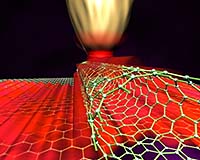
Tempe AZ (SPX) Sep 20, 2006 A team of researchers from Arizona State University and Motorola Labs, the applied research arm of Motorola Inc., has developed sensors based on carbon nanotubes, microscopically small structures that posses excellent electronic properties. In early tests, the new devices detected the presence of heavy metal ions in water down to parts per trillion levels. Specifically, the researchers developed a method for applying peptides to single walled carbon nanotubes (SWNT) in field effect transistors. "This is a fairly general sensor platform for all kinds of applications," said Nongjian Tao, an electrical engineering professor at Arizona State University and one of the researchers on the project. "We tested heavy metal ions in water, but the platform can be applied to many other areas to sense toxic chemicals in the air, or they can be used as biosensors when applied to medicine." "Integration of nanosensors into devices and sensor networks will enable the detection of biological and chemical agents at very low concentrations, which could be vital in the areas of public safety and homeland security," added Vida Ilderem, vice president of the Embedded Systems Research Labs at Motorola, Tempe, Ariz. The researchers report the advance in a paper, "Tuning the chemical selectivity of SWNT-FETs for detection of heavy metal ions," which will be published in the journal Small. An early view of the article is available at the journal's web site (www3.interscience.wiley.com/cgi-bin/jissue/109627347). "Our sensor is based on the novel properties of peptides and carbon nanotubes," Tao explained. "Peptides can be used to recognize and detect various chemical species with high sensitivity and selectivity while carbon nanotubes are well known for their electronic properties." The peptides are made of 20 or so amino acids, so changing the sequence of amino acids allows the researchers to "tune the peptides and recognize different compounds," Tao said. "We developed a simple way to attach different peptides to different nanotubes." Erica Forzani, an ASU assistant research professor in electrical engineering, said the peptides are selective to specific compounds. In the heavy metal tests, the researchers developed a peptide to detect nickel and one to detect copper. If the nickel peptide were used, it would only detect the presence of nickel and be "blind" to any other heavy metal ion (copper, lead or zinc) passing over the carbon nanotubes. Tao added it's the combination of the structure of the nanotubes and the selectivity of the peptides that make the devices so powerful. "The nanotubes basically are a sheet of interconnected atoms rolled into a tube," Tao said. "Every single atom in the tube is exposed to the environment and can interact with chemicals and molecules. That is why it is so sensitive. But without the peptides, it would not recognize specific compounds." "The potential for the carbon nanotubes is extraordinary," Forzani added, "because with a very simple device that does not require sophisticated electronic circuitry, you can detect very low concentrations of analytes." The researchers now will investigate the use of the sensors on biological molecules, like RNA sequence detection, Tao and Forzani said. Community Email This Article Comment On This Article Related Links Arizona State University Nano Technology News From SpaceMart.com Nano Technology News From SpaceMart.com Computer Chip Architecture, Technology and Manufacture
 Biodegradable Napkin With Sensitive Nanofibers May Quickly Detect Biohazards
 Ithaca NY (SPX) Sep 12, 2006
Detecting bacteria, viruses and other dangerous substances in hospitals, airplanes and other commonly contaminated places could soon be as easy as wiping a napkin or paper towel across a surface, says a researcher from Cornell University. |
|
|

| The content herein, unless otherwise known to be public domain, are Copyright 1995-2006 - SpaceDaily.AFP and UPI Wire Stories are copyright Agence France-Presse and United Press International. ESA PortalReports are copyright European Space Agency. All NASA sourced material is public domain. Additionalcopyrights may apply in whole or part to other bona fide parties. Advertising does not imply endorsement,agreement or approval of any opinions, statements or information provided by SpaceDaily on any Web page published or hosted by SpaceDaily. Privacy Statement |