|
 |
 |
 |
 |
 |
 |
 |
 |

 |
Most Of Arctic's Near-Surface Permafrost May Thaw By 2100
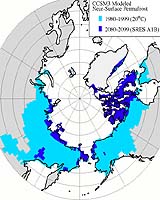
Boulder CO (SPX) Dec 19, 2005 Global warming may decimate the top 10 feet (3 meters) or more of perennially frozen soil across the Northern Hemisphere, altering ecosystems as well as damaging buildings and roads across Canada, Alaska, and Russia. New simulations from the National Center for Atmospheric Research (NCAR) show that over half of the area covered by this topmost layer of permafrost could thaw by 2050 and as much as 90 percent by 2100. Scientists expect the thawing to increase runoff to the Arctic Ocean and release vast amounts of carbon into the atmosphere. The study, using the NCAR-based Community Climate System Model (CCSM), is the first to examine the state of permafrost in a global model that includes interactions among the atmosphere, ocean, land, and sea ice as well as a soil model that depicts freezing and thawing. Results appear online in the December 17 issue of Geophysical Research Letters. "People have used models to study permafrost before, but not within a fully interactive climate system model," says NCAR's David Lawrence, the lead author. The coauthor is Andrew Slater of the University of Colorado's National Snow and Ice Data Center. About a quarter of the Northern Hemisphere's land contains permafrost, defined as soil that remains below 32 degrees F (0 degrees C) for at least two years. Permafrost is typically characterized by an active surface layer, extending anywhere from a few centimeters to several meters deep, which thaws during the summer and refreezes during the winter. The deeper permafrost layer remains frozen. The active layer responds to changes in climate, expanding downward as surface air temperatures rise. Deeper permafrost has not thawed since the last ice age, over 10,000 years ago, and will be largely unaffected by global warming in the coming century, says Lawrence. Recent warming has degraded large sections of permafrost across central Alaska, with pockets of soil collapsing as the ice within it melts. The results include buckled highways, destabilized houses, and "drunken forests"--trees that lean at wild angles. In Siberia, some industrial facilities have reported significant damage. Further loss of permafrost could threaten migration patterns of animals such as reindeer and caribou. The CCSM simulations are based on high and low projections of greenhouse-gas emissions for the 21st century, as constructed by the Intergovernmental Panel on Climate Change. In both cases, the CCSM determined which land areas would retain permafrost at each of 10 soil depths extending down to 11.2 feet (3.43 meters). For the high-emission scenario, the area with permafrost in any of these layers shrinks from 4 million to just over 1 million square miles by the year 2050 and decreases further to about 400,000 square miles (1 million square kilometers) by 2100. In the low-emission scenario, which assumes major advances in conservation and alternative energy, the permafrost area shrinks to about 1.5 million square miles by 2100. "Thawing permafrost could send considerable amounts of water to the oceans," says Slater, who notes that runoff to the Arctic has increased about 7 percent since the 1930s. In the high-emission simulation, runoff grows by another 28 percent by the year 2100. That increase includes contributions from enhanced rainfall and snowfall as well as the water from ice melting within soil. The new study highlights concern about emissions of greenhouse gases from thawing soils. Permafrost may hold 30% or more of all the carbon stored in soils worldwide. As the permafrost thaws, it could lead to large-scale emissions of methane or carbon dioxide beyond those produced by fossil fuels. "There's a lot of carbon stored in the soil," says Lawrence. "If the permafrost does thaw, as our model predicts, it could have a major influence on climate." To address this and other questions, Lawrence and colleagues are now working to develop a more advanced model with interactive carbon. This study was funded by the National Science Foundation, which is NCAR'S primary sponsor, and the U.S. Department of Energy. The National Snow and Ice Data Center (NSIDC) is part of the Cooperative Institute for Research in Environmental Sciences at the University of Colorado. Community Email This Article Comment On This Article Related Links NCAR National Snow and Ice Data Center SpaceDaily Search SpaceDaily Subscribe To SpaceDaily Express Nuclear Space Technology at Space-Travel.com
 Rewriting Glacial History In Pacific North America
 Edmonton AB (SPX) Jan 10, 2006
Although the story on glacier fluctuations in northwestern North America over the last 10,000 years has remained largely unchanged for decades, new evidence discovered by a University of Alberta researcher will rewrite that glacial history and offer clues about our climate history during the last several thousand years. |
|
|

| The content herein, unless otherwise known to be public domain, are Copyright 1995-2006 - SpaceDaily.AFP and UPI Wire Stories are copyright Agence France-Presse and United Press International. ESA PortalReports are copyright European Space Agency. All NASA sourced material is public domain. Additionalcopyrights may apply in whole or part to other bona fide parties. Advertising does not imply endorsement,agreement or approval of any opinions, statements or information provided by SpaceDaily on any Web page published or hosted by SpaceDaily. Privacy Statement |