|
 |
 |
 |
 |
 |
 |
 |
 |

 |
Moss In Space Project Shows How Some Plants Grow Without Gravity
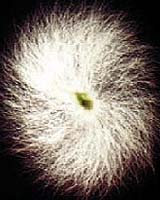
Columbus OH (SPX) Jan 27, 2005 Experiments on moss grown aboard two space shuttle Columbia missions showed that the plants didn't behave as scientists expected them to in the near-absence of gravity. The common roof moss (Ceratodon purpureus) grew in striking, clockwise spirals, according to Fred Sack, the study's lead investigator and a professor of plant cellular and molecular biology at Ohio State University. He and his colleagues noted this even in moss cultures grown aboard the second of the two space shuttle missions, STS-107, which had disintegrated upon its reentry in early 2003. Most of the hardware that contained the moss was later recovered on the ground, with some of the moss cultures still intact. The researchers expected random, unorganized growth, as seen with every other type of plant flown in space. "We don't know why moss grew non-randomly in space, but we found distinct spiral patterns," Sack said. He and his colleagues report their findings in the current online edition of the journal Planta. Common roof moss is a relatively primitive plant in which certain cells, called tip cells, are guided by gravity in their growth. This gravity response is only seen when moss is kept in the dark, as light overrides gravity's effect. Moss originates from chains of cells with growth only taking place in the tip-most cell of a chain. When grown in the dark, the tip cells grow away from gravity's pull this gets the cells out of the soil and into the light. The way these tip cells respond to gravity is exceptional, Sack said. In most plants, gravity guides the growth of roots or stems, which are made up of many cells. But in moss it is just a single cell that both senses and responds to gravity. Common roof moss was grown in Petri dishes in lockers aboard two Columbia shuttle missions the first in 1997 and the other in early 2003. Although most of the experimental moss hardware from this mission was later recovered on the ground, only 11 of the 87 recovered cultures grown on this flight were usable. Astronauts followed similar experimental procedures on both flights. The astronauts chemically fixed the moss cultures before each mission reentered Earth's atmosphere. This process stopped all growth in the moss. Control studies conducted at Kennedy Space Center in Florida used hardware and procedures similar to those used aboard each flight. However, these moss cultures were either kept stationary or turned at a slow spin on a clinostat a machine that resembles a record turntable placed on its edge, and is used to negate the effects of gravity. On earth gravity controls the direction of moss growth so thoroughly that it grows straight away from the center of the earth, just like shoots in a field of corn. In space, scientists expected the cells to grow erratically in all directions since there was no gravity cue. Instead, the moss grew non-randomly in two successive types of patterns: The first pattern resembled that of spokes in a wheel, where the cells grew outward from where they were originally sown. Later, the tips of the filaments grew in arcs so that the entire culture showed clockwise spirals. The same patterns were found when the moss was grown on a clinostat on the ground. Even with the limited data from STS-107, 10 of the 11 salvageable moss cultures showed this kind of strong radial growth and spiraling. Ground controls grown in normal conditions of gravity grew as moss normally would on earth. The results are unusual, Sack said, as this is the first time researchers report seeing this kind of plant growth response in space. "Unlike the ordered response of moss cells in space, other types of plants grow randomly," he said. "So in moss, gravity must normally mask a default growth pattern. This pattern is only revealed when the gravity signal is lost or disrupted. "The fascinating question is why would moss have a backup growth response to conditions it has never experienced on earth? Perhaps spirals are a vestigial growth pattern, a pattern that later became masked when moss evolved the ability to respond to gravity. Sack conducted the study with Volker Kern, who is now at Kennedy Space Center and was at Ohio State at the time of the study; David Reed, with Bionetics Corp. based at Kennedy Space Center; with former Ohio State colleagues Jeanette Nadeau, Jochen Schwuchow and Alexander Skripnikov; and with Jessica Lucas, a graduate student in Sack's lab. Support for this research came from the Exploration Systems Mission Directorate of the National Aeronautics and Space Administration. Community Email This Article Comment On This Article Related Links Ohio State University SpaceDaily Search SpaceDaily Subscribe To SpaceDaily Express Space Shuttle News at Space-Travel.Com
 NASA's Soyuz Deal Will Not Scrap Shuttle
 Washington DC (SPX) Jan 11 2006
NASA's announcement last week that it will pay Roskosmos $43.8 million to transport one astronaut to and another one from the International Space Station this year represents the agency's acknowledgment that it has no immediate alternative if it wishes to continue its presence and participation in the orbiting facility. |
|
|

| The content herein, unless otherwise known to be public domain, are Copyright 1995-2006 - SpaceDaily.AFP and UPI Wire Stories are copyright Agence France-Presse and United Press International. ESA PortalReports are copyright European Space Agency. All NASA sourced material is public domain. Additionalcopyrights may apply in whole or part to other bona fide parties. Advertising does not imply endorsement,agreement or approval of any opinions, statements or information provided by SpaceDaily on any Web page published or hosted by SpaceDaily. Privacy Statement |