|
 |
 |
 |
 |
 |
 |
 |
 |

 |
Moscows Move In Iran Crisis
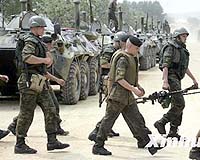
Washington (UPI) Apr 10, 2006 There has been increasing speculation that if Tehran does not agree to American demands regarding its nuclear activities, the Bush administration might consider launching military strikes against Iran in order to destroy the facilities Washington fears it might use to fabricate nuclear weapons. If such an American use of force against Iran does appear increasingly likely, how will Russia react? This is obviously not something that can be foretold before the situation actually arises. Moscow itself is probably not certain what it will do. One way, though, to explore the possibilities of how governments might react to various scenarios is through role-playing games. These exercises are useful since they quickly show both how a given scenario creates different problems for different governments, and how difficult it is to address problems either unilaterally or in cooperation with others. To test how Moscow might react to an escalating Iranian-American confrontation, I recently ran a role playing game with this scenario in my undergraduate Russian politics class at George Mason University. Russia, the U.S., and Iran were each played by teams with four students apiece. Others actors (including China, Britain, France, India, Pakistan, Afghanistan, Saudi Arabia, Israel, Hamas, and al-Qaida) were played by smaller teams, or even just by one student. Once the game started, the situation quickly grew complex. The American and Iranian teams, not surprisingly, undertook most of the action. What we are interested in here, though, are Russia's moves. What the Russian team tried to do at first was come up with a diplomatic solution that would resolve the crisis peacefully. Succeeding at this would not only allow Russia to retain its relations with both America and Iran, but would also demonstrate Moscow's importance to both. But neither the U.S. nor Iran paid any attention to Russia. Both were intent on pursuing confrontation instead. When it became clear that an American attack was imminent, the Russian team announced an extraordinary measure: the deployment of Russian troops to strategic sites in Iran. The fact that the Russian team in my class took this step does not mean that the Russian government itself would do so (or the Iranian government would accept it) if an American attack on Iran really was imminent. Such a move, though, might well be attractive to Moscow for several reasons: 1) it might succeed in deterring an American attack; 2) it would move Russia from the periphery to the center of the diplomatic effort to resolve the crisis; and 3) it holds out the promise of increased Russian influence in oil-rich Iran. While Washington would clearly be angry about this move, other governments and Western public opinion might welcome it if Moscow could convince them that Russia was only doing this to prevent America and/or Israel from undertaking anything "foolish." Even if the U.S. did attack Iran with them there, Washington might pull its punches to avoid hitting Russian troops -- and thus the Iranian nuclear sites they were deployed in and around. Washington would indeed have to think very carefully before attacking Iranian sites where Russian troops were located since it would not want a confrontation with Iran to escalate into a confrontation with Russia too. Because the deployment of a "limited contingent" of Russian troops to Iran would provide several possible benefits to both Moscow and Tehran during an escalating Iranian-American crisis, the possibility that this scenario could occur must be taken seriously. For if the advantages of such a move were obvious to my undergraduates playing the parts of Moscow and Tehran, they may also be obvious to the Russian and Iranian governments. Mark N. Katz is a professor of government and politics at George Mason University.
Source: United Press International Community Email This Article Comment On This Article Related Links - Learn about nuclear weapons doctrine and defense at SpaceWar.com Learn about missile defense at SpaceWar.com All about missiles at SpaceWar.com Learn about the Superpowers of the 21st Century at SpaceWar.com
 North Korean Defense Chief Warns Of Pre-Emptive Attack On US
 Seoul (AFP) Apr 10, 2006
North Korea's defense chief has warned that Pyongyang could also launch a preemptive attack against the United States, with state media saying soldiers were ready to be "human bombs." |
|
|

| The content herein, unless otherwise known to be public domain, are Copyright 1995-2006 - SpaceDaily.AFP and UPI Wire Stories are copyright Agence France-Presse and United Press International. ESA PortalReports are copyright European Space Agency. All NASA sourced material is public domain. Additionalcopyrights may apply in whole or part to other bona fide parties. Advertising does not imply endorsement,agreement or approval of any opinions, statements or information provided by SpaceDaily on any Web page published or hosted by SpaceDaily. Privacy Statement |