|
 |
 |
 |
 |
 |
 |
 |
 |

 |
Moon Storms
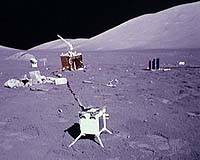
Huntsville AL (SPX) Dec 12, 2005 Every lunar morning, when the sun first peeks over the dusty soil of the moon after two weeks of frigid lunar night, a strange storm stirs the surface. The next time you see the moon, trace your finger along the terminator, the dividing line between lunar night and day. That's where the storm is. It's a long and skinny dust storm, stretching all the way from the north pole to the south pole, swirling across the surface, following the terminator as sunrise ceaselessly sweeps around the moon. Never heard of it? Few have. But scientists are increasingly confident that the storm is real. The evidence comes from an old Apollo experiment called LEAM, short for Lunar Ejecta and Meteorites. "Apollo 17 astronauts installed LEAM on the moon in 1972," explains Timothy Stubbs of the Solar System Exploration Division at NASA's Goddard Space Flight Center. "It was designed to look for dust kicked up by small meteoroids hitting the moon's surface." Billions of years ago, meteoroids hit the moon almost constantly, pulverizing rocks and coating the moon's surface with their dusty debris. Indeed, this is the reason why the moon is so dusty. Today these impacts happen less often, but they still happen. Apollo-era scientists wanted to know, how much dust is ejected by daily impacts? And what are the properties of that dust? LEAM was to answer these questions using three sensors that could record the speed, energy, and direction of tiny particles: one each pointing up, east, and west. LEAM's three-decade-old data are so intriguing, they're now being reexamined by several independent groups of NASA and university scientists. Gary Olhoeft, professor of geophysics at the Colorado School of Mines in Golden, is one of them: "To everyone's surprise," says Olhoeft, "LEAM saw a large number of particles every morning, mostly coming from the east or west--rather than above or below--and mostly slower than speeds expected for lunar ejecta." What could cause this? Stubbs has an idea: "The dayside of the moon is positively charged; the nightside is negatively charged." At the interface between night and day, he explains, "electrostatically charged dust would be pushed across the terminator sideways," by horizontal electric fields. (Learn more: "Moon Fountains." ) Even more surprising, Olhoeft continues, a few hours after every lunar sunrise, the experiment's temperature rocketed so high--near that of boiling water--that "LEAM had to be turned off because it was overheating." Those strange observations could mean that "electrically-charged moondust was sticking to LEAM, darkening its surface so the experiment package absorbed rather than reflected sunlight," speculates Olhoeft. But nobody knows for sure. LEAM operated for a very short time: only 620 hours of data were gathered during the icy lunar night and a mere 150 hours of data from the blazing lunar day before its sensors were turned off and the Apollo program ended. Astronauts may have seen the storms, too. While orbiting the Moon, the crews of Apollo 8, 10, 12, and 17 sketched "bands" or "twilight rays" where sunlight was apparently filtering through dust above the moon's surface. This happened before each lunar sunrise and just after each lunar sunset. NASA's Surveyor spacecraft also photographed twilight "horizon glows," much like what the astronauts saw. It's even possible that these storms have been spotted from Earth: For centuries, there have been reports of strange glowing lights on the moon, known as "lunar transient phenomena" or LTPs. Some LTPs have been observed as momentary flashes--now generally accepted to be visible evidence of meteoroids impacting the lunar surface. But others have appeared as amorphous reddish or whitish glows or even as dusky hazy regions that change shape or disappear over seconds or minutes. Early explanations, never satisfactory, ranged from volcanic gases to observers' overactive imaginations (including visiting extraterrestrials). Now a new scientific explanation is gaining traction. "It may be that LTPs are caused by sunlight reflecting off rising plumes of electrostatically lofted lunar dust," Olhoeft suggests. All this matters to NASA because, by 2018 or so, astronauts are returning to the Moon. Unlike Apollo astronauts, who never experienced lunar sunrise, the next explorers are going to establish a permanent outpost. They'll be there in the morning when the storm sweeps by. The wall of dust, if it exists, might be diaphanous, invisible, harmless. Or it could be a real problem, clogging spacesuits, coating surfaces and causing hardware to overheat. Which will it be? Says Stubbs, "we've still got a lot to learn about the Moon." Community Email This Article Comment On This Article Related Links The Lunar Ejecta and Meteorite Experiment Lunar transient phenomena A catalogue of LTPs SpaceDaily Search SpaceDaily Subscribe To SpaceDaily Express Mars News and Information at MarsDaily.com Lunar Dreams and more
 SMART 1 Uses New Imaging Technique In Lunar Orbit
 Paris, France (ESA) Dec 28, 2005
ESA's SMART-1 spacecraft has been surveying the Moon's surface in visible and near-infrared light using a new technique, never before tried in lunar orbit. |
|
|

| The content herein, unless otherwise known to be public domain, are Copyright 1995-2006 - SpaceDaily.AFP and UPI Wire Stories are copyright Agence France-Presse and United Press International. ESA PortalReports are copyright European Space Agency. All NASA sourced material is public domain. Additionalcopyrights may apply in whole or part to other bona fide parties. Advertising does not imply endorsement,agreement or approval of any opinions, statements or information provided by SpaceDaily on any Web page published or hosted by SpaceDaily. Privacy Statement |