|
 |
 |
 |
 |
 |
 |
 |
 |

 |
Monkeys Can Perform Mental Addition
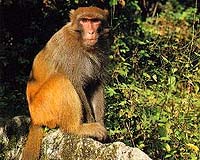
Durham NC (SPX) Dec 19, 2007 Researchers at Duke University have demonstrated that monkeys have the ability to perform mental addition. In fact, monkeys performed about as well as college students given the same test. The findings shed light on the shared evolutionary origins of arithmetic ability in humans and non-human animals, according to Assistant Professor Elizabeth Brannon, Ph.D. and Jessica Cantlon, Ph.D., of the Duke Center for Cognitive Neuroscience. Current evidence has shown that both humans and animals have the ability to mentally represent and compare numbers. For instance, animals, infants and adults can discriminate between four objects and eight objects. However, until now it was unclear whether animals could perform mental arithmetic. "We know that animals can recognize quantities, but there is less evidence for their ability to carry out explicit mathematical tasks, such as addition," said graduate student Jessica Cantlon. "Our study shows that they can." Cantlon and Brannon set up an experiment in which macaque monkeys were placed in front of a computer touch screen displaying a variable number of dots. Those dots were then removed and a new screen appeared with a different number of dots. A third screen then appeared displaying two boxes; one containing the sum of the first two sets of dots and one containing a different number. The monkeys were rewarded for touching the box containing the correct sum of the sets. The same test was presented to college students, who were asked to choose the correct sum without counting the individual dots. While the college students were correct 94 percent the time and the monkeys 76 percent, the average response time for both monkeys and humans was about one second. Interestingly, both the monkeys' and the college students' performance worsened when the two choice boxes were close in number. "If the correct sum was 11 and the box with the incorrect number held 12 dots, both monkeys and the college students took longer to answer and had more errors. We call this the ratio effect," explained Cantlon. "What's remarkable is that both species suffered from the ratio effect at virtually the same rate." That monkeys and humans share the ability to add suggests that basic arithmetic may be part of our shared evolutionary past. Humans have added language and writing to their repertoire, which undoubtedly changes the way we represent numbers. "Much of adult humans' mathematical capacity lies in their ability to represent numerical concepts using symbolic language. A monkey can't tell the difference between 2000 and 2001 objects, for instance. However, our work has shown that both humans and monkeys can mentally manipulate representations of number to generate approximate sums of individual objects," says Brannon. Community Email This Article Comment On This Article Related Links Duke University Medical Center All About Human Beings and How We Got To Be Here
 Researchers Reveal The Biology Of Shivering
 Portland OR (SPX) Dec 18, 2007
Researchers at Oregon Health and Science University's Neurological Sciences Institute have uncovered the system that tells the body when to perform one of its most basic defenses against the cold: shivering. The scientists have discovered the brain's wiring system, which takes temperature information from the skin and determines when a person should start shivering. Their findings are published in the advance online edition of the journal Nature Neuroscience. |
|
|

| The content herein, unless otherwise known to be public domain, are Copyright 1995-2007 - SpaceDaily.AFP and UPI Wire Stories are copyright Agence France-Presse and United Press International. ESA Portal Reports are copyright European Space Agency. All NASA sourced material is public domain. Additional copyrights may apply in whole or part to other bona fide parties. Advertising does not imply endorsement,agreement or approval of any opinions, statements or information provided by SpaceDaily on any Web page published or hosted by SpaceDaily. Privacy Statement |