|
 |
 |
 |
 |
 |
 |
 |
 |

 |
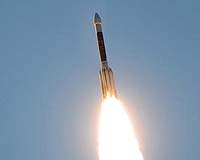
Modernized GPS Satellite Built By Lockheed Martin Launched From Cape Canaveral
Cape Canaveral FL (SPX) Dec 21, 2007 A U.S. Air Force modernized Global Positioning System Block IIR (GPS IIR-M) satellite, designed and built by Lockheed Martin, was launched successfully from Cape Canaveral Air Force Station aboard a United Launch Alliance (ULA) Delta II launch vehicle. Designated GPS IIR-18M, the satellite is the fifth in a series of eight Block IIR-M spacecraft that Lockheed Martin Navigation Systems has modernized for its customer, the Global Positioning Systems Wing, Space and Missile Systems Center, Los Angeles Air Force Base, Calif. The Block IIR-M series includes new features that enhance operations and navigation signal performance for military and civilian GPS users around the globe. "The successful deployment of this high-performance satellite represents another important milestone in the modernization of the GPS constellation and reflects our commitment to achieving mission success for our customer," said Don DeGryse, Lockheed Martin's vice president of Navigation Systems. "Our team is now focused on performing a rapid and efficient on-orbit checkout to quickly place the satellite's advanced navigational capabilities into operational service." Representing the second successful GPS IIR-M mission in just two months, the satellite joins four IIR-M satellites and 12 other operational Block IIR satellites within the current 30-spacecraft constellation. Each IIR-M satellite includes a modernized antenna panel that provides increased signal power to receivers on the ground, two new military signals for improved accuracy, enhanced encryption and anti-jamming capabilities for the military, and a second civil signal that will provide users with an open access signal on a different frequency. The Global Positioning System enables properly equipped users to determine precise time and velocity and worldwide latitude, longitude and altitude to within a few meters. Air Force Space Command's 2nd Space Operations Squadron (2 SOPS) at Schriever Air Force Base, Colo., manages and operates the GPS constellation for both civil and military users. Lockheed Martin is also leading a team which includes ITT and General Dynamics in the competition to build the U.S. Air Force's next-generation Global Positioning System, GPS Block III. The next-generation program will improve position, navigation, and timing services for the warfighter and civil users worldwide and provide advanced anti-jam capabilities yielding improved system security, accuracy and reliability. A multi-billion dollar development contract is scheduled to be awarded by the Global Positioning Systems Wing, Space and Missile Systems Center, Los Angeles Air Force Base, Calif. in early 2008. Community Email This Article Comment On This Article Related Links GPS Applications, Technology and Suppliers
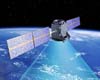
 Two Years In Space For Galileo Satellite
 Paris, France (SPX) Dec 20, 2007
On 28 December, it will be two years since GIOVE-A - the first Galileo satellite - was launched by a Soyuz rocket from Baikonur, in Kazakhstan. This satellite demonstrates the progress Europe has made in setting up its own navigation system. Since January 2006, Galileo signals have been broadcast by GIOVE-A, and received all around the globe. |
|
|

| The content herein, unless otherwise known to be public domain, are Copyright 1995-2007 - SpaceDaily.AFP and UPI Wire Stories are copyright Agence France-Presse and United Press International. ESA Portal Reports are copyright European Space Agency. All NASA sourced material is public domain. Additional copyrights may apply in whole or part to other bona fide parties. Advertising does not imply endorsement,agreement or approval of any opinions, statements or information provided by SpaceDaily on any Web page published or hosted by SpaceDaily. Privacy Statement |