|
 |
 |
 |
 |
 |
 |
 |
 |

 |
Modeling Of Long-Term Fossil Fuel Consumption Shows 14.5 Degree Hike In Temperature
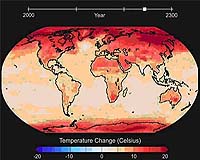
Livermore CA (SPX) Nov 01, 2005 If humans continue to use fossil fuels in a business as usual manner for the next several centuries, the polar ice caps will be depleted, ocean sea levels will rise by seven meters and median air temperatures will soar 14.5 degrees warmer than current day. These are the stunning results of climate and carbon cycle model simulations conducted by scientists at the Lawrence Livermore National Laboratory. By using a coupled climate and carbon cycle model to look at global climate and carbon cycle changes, the scientists found that the earth would warm by 8 degrees Celsius (14.5 degrees Fahrenheit) if humans use the entire planet's available fossil fuels by the year 2300. The jump in temperature would have alarming consequences for the polar ice caps and the ocean, said lead author Govindasamy Bala of the Laboratory's Energy and Environment Directorate. In the polar regions alone, the temperature would spike more than 20 degrees Celsius, forcing the land in the region to change from ice and tundra to boreal forests. "The temperature estimate is actually conservative because the model didn't take into consideration changing land use such as deforestation and build out of cities into outlying wilderness areas," Bala said. Today's level of atmospheric carbon dioxide is 380 parts per million (ppm). By the year 2300, the model predicts that amount would nearly quadruple to 1,423 ppm. In the simulations, soil and living biomass are net carbon sinks, which would extract a significant amount of carbon dioxide that otherwise, would be remaining in the atmosphere from the burning of fossil fuels. However, the real scenario might be a bit different. "The land ecosystem would not take up as much carbon dioxide as the model assumes," Bala said. "In fact in the model, it takes up much more carbon than it would in the real world because the model did not have nitrogen/nutrient limitations to uptake. We also didn't take into account land use changes, such as the clearing of forests." The model shows that ocean uptake of CO2 begins to decrease in the 22nd and 23rd centuries due to the warming of the ocean surface that drives CO2 fluctuations out of the ocean. It takes longer for the ocean to absorb CO2 than biomass and soil. By the year 2300, about 38 percent and 17 percent of the carbon dioxide released from the burning of all fossil fuels are taken up by land and the ocean, respectively. The remaining 45 percent stays in the atmosphere. Whether carbon dioxide is released in the atmosphere or the ocean, eventually about 80 percent of the carbon dioxide will end up in the ocean in a form that will make the ocean more acidic. While the carbon dioxide is in the atmosphere, it could produce adverse climate change. When it enters the ocean, the acidification could be harmful to marine life. The models predict quite a drastic change not only in the temperature of the oceans but also in its acidity content, that would become especially harmful for marine organisms with shells and skeletal material made out of calcium carbonate. Calcium carbonate organisms, such as coral, serve as climate-stabilizers. When the organisms die, their carbonate shells and skeletons settle to the ocean floor, where some dissolve and some are buried in sediments. These deposits help regulate the chemistry of the ocean and the amount of carbon dioxide in the atmosphere. However, earlier Livermore research found that unrestrained release of fossil-fuel carbon dioxide to the atmosphere could threaten extinction for these climate-stabilizing marine organisms. "The doubled-CO2 climate that scientists have warned about for decades is beginning to look like a goal we might attain if we work hard to limit CO2 emissions, rather than the terrible outcome that might occur if we do nothing," said Ken Caldeira, of the Department of Global Ecology at the Carnegie Institution and one of the other authors. Bala said the most drastic changes during the 300-year period would be during the 22nd century in which precipitation change, an increase in atmospheric precipitable water and a decrease in sea ice size are the largest when emissions rates are the highest. During the model runs, sea ice cover disappears almost completely in the northern hemisphere by the year 2150 during northern hemisphere summers. "We took a very holistic view," Bala said. "What if we burn everything? It will be a wake up call in climate change." As for the global warming skeptics, Bala said the proof is already evident. "Even if people don't believe in it today, the evidence will be there in 20 years," he said. "These are long-term problems." He pointed to the 2003 European heat wave, and the 2005 Atlantic hurricane season as examples of extreme climate change. "We definitely know we are going to warm over the next 300 years," he said. "In reality, we may be worse off than we predict." Other Livermore authors include Arthur Mirin and Michael Wickett, and Christine Delire of ISE-M at the Universit� Montepellier II. The research appears in the Nov. 1 issue of the American Meteorological Society's Journal of Climate. Community Email This Article Comment On This Article Related Links Lawrence Livermore National Laboratory SpaceDaily Search SpaceDaily Subscribe To SpaceDaily Express Climate Science News - Modeling, Mitigation Adaptation
 The Forgotten Methane Source
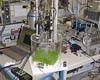 Heidelberg, Germany (SPX) Jan 11, 2006
In the last few years, more and more research has focused on the biosphere; particularly, on how gases which influence the climate are exchanged between the biosphere and atmosphere. Researchers from the Max Planck Institute for Nuclear Physics have now carefully analysed which organic gases are emitted from plants. |
|
|

| The content herein, unless otherwise known to be public domain, are Copyright 1995-2006 - SpaceDaily.AFP and UPI Wire Stories are copyright Agence France-Presse and United Press International. ESA PortalReports are copyright European Space Agency. All NASA sourced material is public domain. Additionalcopyrights may apply in whole or part to other bona fide parties. Advertising does not imply endorsement,agreement or approval of any opinions, statements or information provided by SpaceDaily on any Web page published or hosted by SpaceDaily. Privacy Statement |