|
 |
 |
 |
 |
 |
 |
 |
 |

 |
Mob Rules
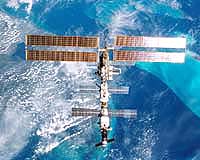
Cambridge, MA (SPX) Jun 21, 2004 Atoms and molecules, en masse, can do almost anything, and physicists know it. In fact, they dream about it. By combining the right kinds of molecules under the right conditions, it should be possible to craft, e.g., uncrackable metal alloys, room-temperature superconductors, self-healing spaceship skins impervious to meteoroids and solar flares. You name it. The promise of "designer materials" is great, but there's a problem: Crowds of molecules, like crowds of people, can be hard to predict. Only in idealized cases do physicists have simple rules, like the ideal gas law, to help them describe many-particle systems. Sometimes those rules work well. The wonder of designer materials, however, lies beyond the ideal. Physics can deal handily with one or two particles. Newton's laws, for instance, describe the motion of a single planet around the sun so simply and beautifully that school children can solve the equations. Now add another planet; all three bodies (sun, planet and planet) tug on each other as they move. The "three body problem" is famously complicated; computers are required to solve it exactly. There's a three-body problem in quantum mechanics, too. Schrodinger's equation is easy to solve for two particles, e.g., an electron and a proton in a hydrogen atom. Add one more electron and, once again, a computer is required. Now imagine, not three, but 10 (to the power of 23) particles. That's the number of atoms or molecules in, say, a tablespoon of water. They tug on each other, bond with each other, crash into each other. The number of interactions going on at any instant is mind-boggling. "It's impossible to solve the equations exactly for such a system," says physicist Peter J. Lu of Harvard University. "With 10(23) particles, you have to write down a term for each interaction. So, of course, you make approximations because the exact calculation is far, far beyond anyone's (or any computer's) abilities." What do you do when even supercomputers can't handle the math? Enter the International Space Station (ISS). Lu and his PhD thesis adviser Prof. David Weitz are testing a device onboard the ISS that might succeed, in some respects, where supercomputers fail. It's simple: Take a jar of "organic goop," says Lu, and mix in millions of tiny Plexiglas spheres. Add some molecular coils, billions of them, and float the mixture in space. This "device" is a colloidal mixture, and it's a good model for many-particle interactions. Colloids are systems of tiny particles suspended in fluid. (Pulpy orange juice is an everyday example.) Physicists have known for a long time that carefully crafted colloids could be used to simulate swarms of atoms or molecules. Colloidal particles arrange themselves as crystals; flow like fluids; expand and contract like a gas. They exhibit all the mob behaviors of molecules, with a big advantage: "We can see colloids," says Lu. While it's impossible to watch individual atoms or molecules, colloidal particles are big enough to see through an ordinary microscope. Their interactions, and the structures they form, can be observed directly. No supercomputer required! On Earth colloidal simulations are limited. The particles, weighted by gravity, tend to settle to the bottom of the jar. Floating onboard the ISS, however, they remain suspended, interacting for as long as a physicist cares to watch. What kinds of atoms and molecules do colloids mimic? It depends on the make-up of the colloid. Some colloid-spheres can carry a charge, "so we can make them attract or repel" like ions, says Lu. "We can also mix colloids of different sizes, and vary their ratios to grow a host of different crystal structures that mimic real materials." The possibilities are endless. But the research is just beginning. In recent months, Weitz, Lu and colleagues at the University of Edinburgh (led by Prof. Peter Pusey) have been working with six simple colloids onboard the ISS. Astronauts do the actual work; Weitz et al. Send directions from the ground. The name of the experiment is BCAT-3, short for Binary Colloid Alloy Test-3. One of the colloids, Lu's favorite, is made of 400-nanometer Plexiglas spheres, polymer coils (long molecules coiled up like a Slinky), and an organic fluid similar to gasoline. The spheres are stand-ins for atoms or molecules. The polymer coils force the spheres to interact. Lu explains: "Polymer coils act like an ideal gas. They swarm through the liquid, applying pressure to the bigger spheres. When two spheres approach one another, the gap between them becomes too small for the coils. Inside the gap, pressure drops and the spheres are pulled together. By controlling the size and concentration of the polymer coils, we control the strength of interactions between the Plexiglas spheres." This colloid mixture turns out to be a promising model for supercritical fluids. A supercritical fluid is a high-pressure, high-temperature state of matter best described as a liquid-like gas, and a marvelous solvent. Water becomes supercritical in some steam turbines--and it tends to dissolve the tips of the turbine blades. Supercritical carbon dioxide is used to remove caffeine from coffee beans, and sometimes to dry-clean clothes. Liquid-fueled rocket propellant is also supercritical when it emerges from the tail of a spaceship. Of special interest is the "critical point"--the pressure and temperature where a substance becomes supercritical. Near the critical point, matter fluctuates. Bubbles and droplets, some as small as a few atoms, some as wide as the jar itself, appear and disappear, merge and split. Weitz and Lu have been able to observe these kinds of structures in BCAT-3, and they're developing new insights into critical phenomena. It's only a start, says Lu. If you want to design a supercritical fluid ... good luck! Maybe one day, though, all you'll need is a good colloid. Community Email This Article Comment On This Article Related Links SpaceDaily Search SpaceDaily Subscribe To SpaceDaily Express Dirt, rocks and all the stuff we stand on firmly
 Magnetic Reconnection Region Larger Than 2.5 Million Km Found In The Solar Wind
 Paris (ESA) Jan 12, 2006
Using the ESA Cluster spacecraft and the NASA Wind and ACE satellites, a team of American and European scientists have discovered the largest jets of particles created between the Earth and the Sun by magnetic reconnection. This result makes the cover of this week's issue of Nature. |
|
|

| The content herein, unless otherwise known to be public domain, are Copyright 1995-2006 - SpaceDaily.AFP and UPI Wire Stories are copyright Agence France-Presse and United Press International. ESA PortalReports are copyright European Space Agency. All NASA sourced material is public domain. Additionalcopyrights may apply in whole or part to other bona fide parties. Advertising does not imply endorsement,agreement or approval of any opinions, statements or information provided by SpaceDaily on any Web page published or hosted by SpaceDaily. Privacy Statement |