
 |
 |
 |
 |
 |
 |
 |
 |
 |

 |
Mission to bring back soil samples from Mars gets 2018 launch
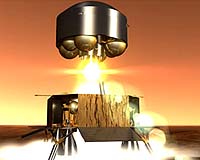
Paris (AFP) July 9, 2008 Space experts on Wednesday set a date of 2018 for launching the Mars Sample Return mission, billed as the most complex and costliest exploration of the Red Planet ever planned. The unmanned mission aims to pick up soil and rocks from Mars and bring them back to Earth, where big labs can wring far more data from them than by remote control using small instruments on a scout vehicle. "2018 will start the era of Mars Sample Return," Doug Mc Cuistion, director of NASA's Mars Exploration Programme, told a press conference. The preliminary report, issued in Paris by a working group, sketched a mission profile and flight design but also cautioned that many challenges lay ahead. Its authors said that, regardless of the start date, it would take five years for the precious 500-gramme (1.1-pound) sample to be brought back to Earth and space powers had to pool resources to achieve the extraordinary goal. Stephane Janichewski, deputy director of France's National Centre for Space Studies (Cnes) said "at least a transatlantic cooperation" was needed between Europe and the United States to fulfil this "very challenging" project. "It's a sort of (Holy) Grail we are looking for," said Janichewski, referring to the project's scope. In the most optimistic scenario, a US Atlas A 551 rocket would lift off in 2018 carrying a mobile rover -- or alternatively, a non-mobile lander -- that would be dropped down to Mars to pick up samples selected to give the broadest picture possible of the planet's geological past. Included in the package would be a small rocket, a Mars Ascent Vehicle, that would later blast off with the sample onboard. In 2019, a European 5 ECA heavy rocket would take off, sending an orbiter to Mars. The Mars Ascent Vehicle would leave the Red Planet with the sample container and drop it off in Martian orbit, where it would be captured by the orbiter. The orbiter would then start the long haul back to Earth, eventually dropping off the sample in an "Earth Entry Vehicle" designed to survive the fiery descent through the terrestrial atmosphere. It would then be retrieved and analysed. Mars has exerted a fascination for thousands of years, reflected in ancient mythology and superstition. Scientists, too, are engrossed with Mars, as it is the most Earth-like planet in the Solar system. "Of the various places of interest for evaluating whether or not life exists or has existed elsewhere in the Universe, Mars is by far the most accessible," the preliminary planning report noted. The document says the cost would roughly range from 4.5 to eight billion dollars (three to 5.3 billion euros), "depending on the final requirements and international cooperative structure." Community Email This Article Comment On This Article Share This Article With Planet Earth
Related Links Mars News and Information at MarsDaily.com Lunar Dreams and more
 Technology Enrolled In Hunt For Life On Mars
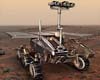 Chapel Hill NC (SPX) Jun 12, 2008
Scientists looking for evidence of life on Mars have turned to technology invented by University of North Carolina at Chapel Hill researchers to help with their mission. |
|
|

| The content herein, unless otherwise known to be public domain, are Copyright 1995-2007 - SpaceDaily.AFP and UPI Wire Stories are copyright Agence France-Presse and United Press International. ESA Portal Reports are copyright European Space Agency. All NASA sourced material is public domain. Additional copyrights may apply in whole or part to other bona fide parties. Advertising does not imply endorsement,agreement or approval of any opinions, statements or information provided by SpaceDaily on any Web page published or hosted by SpaceDaily. Privacy Statement |
 del.icio.us
 Digg
Digg Reddit
 YahooMyWeb
 Google
 Facebook