
 |
 |
 |
 |
 |
 |
 |
 |
 |

 |
Mission Extended As Phoenix Confirms Martian Water
Tucson AZ (SPX) Aug 01, 2008 Laboratory tests aboard NASA's Phoenix Mars Lander have identified water in a soil sample. The lander's robotic arm delivered the sample Wednesday to an instrument that identifies vapors produced by the heating of samples. "We have water," said William Boynton of the University of Arizona, lead scientist for the Thermal and Evolved-Gas Analyzer, or TEGA. "We've seen evidence for this water ice before in observations by the Mars Odyssey orbiter and in disappearing chunks observed by Phoenix last month, but this is the first time Martian water has been touched and tasted." With enticing results so far and the spacecraft in good shape, NASA also announced operational funding for the mission will extend through Sept. 30. The original prime mission of three months ends in late August. The mission extension adds five weeks to the 90 days of the prime mission. "Phoenix is healthy and the projections for solar power look good, so we want to take full advantage of having this resource in one of the most interesting locations on Mars," said Michael Meyer, chief scientist for the Mars Exploration Program at NASA Headquarters in Washington. The soil sample came from a trench approximately 2 inches deep. When the robotic arm first reached that depth, it hit a hard layer of frozen soil. Two attempts to deliver samples of icy soil on days when fresh material was exposed were foiled when the samples became stuck inside the scoop. Most of the material in Wednesday's sample had been exposed to the air for two days, letting some of the water in the sample vaporize away and making the soil easier to handle. "Mars is giving us some surprises," said Phoenix principal investigator Peter Smith of the University of Arizona. "We're excited because surprises are where discoveries come from. One surprise is how the soil is behaving. The ice-rich layers stick to the scoop when poised in the sun above the deck, different from what we expected from all the Mars simulation testing we've done. That has presented challenges for delivering samples, but we're finding ways to work with it and we're gathering lots of information to help us understand this soil." Since landing on May 25, Phoenix has been studying soil with a chemistry lab, TEGA, a microscope, a conductivity probe and cameras. Besides confirming the 2002 finding from orbit of water ice near the surface and deciphering the newly observed stickiness, the science team is trying to determine whether the water ice ever thaws enough to be available for biology and if carbon-containing chemicals and other raw materials for life are present. The mission is examining the sky as well as the ground. A Canadian instrument is using a laser beam to study dust and clouds overhead. "It's a 30-watt light bulb giving us a laser show on Mars," said Victoria Hipkin of the Canadian Space Agency. A full-circle, color panorama of Phoenix's surroundings also has been completed by the spacecraft. "The details and patterns we see in the ground show an ice-dominated terrain as far as the eye can see," said Mark Lemmon of Texas A and M University, lead scientist for Phoenix's Surface Stereo Imager camera. "They help us plan measurements we're making within reach of the robotic arm and interpret those measurements on a wider scale." Community Email This Article Comment On This Article Share This Article With Planet Earth
Related Links Phoenix at LPL Phoenix at NASA Mars News and Information at MarsDaily.com Lunar Dreams and more
 NASA extends 'successful' Phoenix lander mission
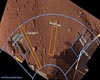 Los Angeles (AFP) July 31, 2008
NASA scientists said Thursday the agency was extending the Mars mission of its Phoenix lander until the end of September, describing its progress so far as "very successful." |
|
|

| The content herein, unless otherwise known to be public domain, are Copyright 1995-2007 - SpaceDaily.AFP and UPI Wire Stories are copyright Agence France-Presse and United Press International. ESA Portal Reports are copyright European Space Agency. All NASA sourced material is public domain. Additional copyrights may apply in whole or part to other bona fide parties. Advertising does not imply endorsement,agreement or approval of any opinions, statements or information provided by SpaceDaily on any Web page published or hosted by SpaceDaily. Privacy Statement |
 del.icio.us
 Digg
Digg Reddit
 YahooMyWeb
 Google
 Facebook