 Missing Link Sought In Planetary Evolution
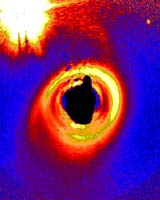
NASA Hubble Space Telescope's new Advanced Camera for Surveys (ACS) has given astronomers their clearest view yet of the dust disk around a young, 5-million-year-old star. Such disks are expected to be the birthplace of planets. The star, called HD 141569A, lies 320 light-years away in the constellation Libra and appears to be a member of a triple-star system. The image at left shows the star and disk as it appears in space. The system is slightly tilted when viewed from Earth. The photo at right portrays the system if astronomers could view it from above. Credit: NASA, M. Clampin (STScI), H. Ford (JHU), G. Illingworth (UCO/Lick), J. Krist (STScI), D. Ardila (JHU), D. Golimowski (JHU), the ACS Science Team and ESA |
Pasadena - Oct 21, 2003
Just as anthropologists sought "the missing link" between apes and humans, astronomers are embarking on a quest for a missing link in planetary evolution. Only instead of dusty fields and worn shovels, their laboratory is the universe, and their tool of choice is NASA's new Space Infrared Telescope Facility.
Launched on Aug.25, NASA's fourth and final Great Observatory will soon set its high-tech infrared eyes on, among other celestial objects, the dusty discs surrounding stars where planets are born.
While other ground- and space-based telescopes have spied these swirling "circumstellar" discs, both young and old, they have missed middle-aged discs for various reasons. The Space Infrared Telescope Facility's unprecedented sensitivity and resolution will allow it to fill in this gap and in the process answer fundamental questions regarding how planets, including those resembling Earth, may form.
"With the Space Infrared Telescope Facility, we anticipate seeing many planetary discs at all stages of development," says Dr. Karl Stapelfeldt of JPL, a scientist with the mission. "By studying how they change over time, we may be able to determine what conditions favor planet formation."
Community
Email This Article
Comment On This Article
Related Links
Space Infrared Telescope Facility
SpaceDaily
Search SpaceDaily
Subscribe To SpaceDaily Express
Lands Beyond Beyond - extra solar planets - news and science
Life Beyond Earth
 Study Highlights Role Of Hit-And-Run Collisions In Planet Formation
 Santa Cruz CA (SPX) Jan 12, 2006
Hit-and-run collisions between embryonic planets during a critical period in the early history of the Solar System may account for some previously unexplained properties of planets, asteroids, and meteorites, according to researchers at the University of California, Santa Cruz, who describe their findings in a paper to appear in the January 12 issue of the journal Nature.
---------------------------------------------------------
New from Telescopes.com!
It's new. And it's downright terrific!
Celestron's CPC Schmidt-Cassegrain telescope is the
scope you've been waiting for! It offers new alignment
technology, advanced engineering, and bold new design at a
new, low price!
In fact, Celestron's Professional Computerized (CPC) scope
with revolutionary SkyAlign Alignment Technology redefines
everything that amateur astronomers are looking for. It offers quick and simple alignment, GPS technology, unsurpassed optical quality, ease of use, advanced ergonomics, enhanced computerization and, most important, affordability.
Want to view M-31 tonight? One button takes you there!
Shop for telescopes online at Telescopes.com! today!
------------------------------------------------------------
|
|
|

| The content herein, unless otherwise known to be public domain, are Copyright 1995-2006 - SpaceDaily.AFP and UPI Wire Stories are copyright Agence France-Presse and United Press International. ESA PortalReports are copyright European Space Agency. All NASA sourced material is public domain. Additionalcopyrights may apply in whole or part to other bona fide parties. Advertising does not imply endorsement,agreement or approval of any opinions, statements or information provided by SpaceDaily on any Web page published or hosted by SpaceDaily. Privacy Statement |
|











