|
 |
 |
 |
 |
 |
 |
 |
 |

 |
Missile Shield Will Start From Pacific Testbed
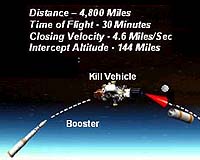
Washington - Dec 18, 2002 In light of the new security environment and progress made to date in missile defense development efforts, the President has directed the Department of Defense to begin fielding initial missile defense capabilities in 2004-2005 to meet the near-term ballistic missile threat to our homeland, our deployed forces, and our friends and allies. This initial capability will build on the planned Pacific Missile Defense Testbed and serve as a starting point for fielding improved, layered missile defense capabilities later. The Department of Defense is employing an evolutionary approach to the development and deployment of missile defenses over time. This means there is no final or fixed missile defense architecture. Rather, the composition of missile defenses, including the number, type, and location of systems deployed, will change over time to meet the changing threat and take advantage of technological developments. This approach includes the use of prototype and test assets to provide early capability, while improving the effectiveness of defensive capabilities over time.
The initial set of capabilities planned for 2004-2005 include:
These initial capabilities may be improved through additional measures:
Because the threats of the 21st century also endanger our friends and allies around the world, it is essential that we work together to meet these threats. The Department of Defense plans to develop and deploy missile defenses capable of protecting not only the United States and our deployed forces, but also friends and allies. The missile defense program will also be structured in a manner that encourages industrial cooperation by friends and allies, consistent with overall U.S. national security. In conjunction with the Department of State, the Department of Defense will promote international missile defense cooperation, including within existing mutual defense structures like NATO, and negotiate appropriate arrangements for this purpose. The deployment of missile defenses is an essential element of our overall national security policy to transform U.S. defense and deterrence capabilities to meet emerging and evolving threats. The evolutionary approach to missile defense provides near-term capability to address the emerging ballistic missile threat and will evolve by the end of the decade into a multi-layered missile defense system capable of providing protection against the full range of limited ballistic missile attacks. This approach is flexible enough to provide defense for the United States and its friends and allies and, by reducing an adversary's confidence in ballistic missiles, can help deter the use of missiles and dissuade countries from acquiring these capabilities at the outset. Community Email This Article Comment On This Article Related Links Missile Defense Agency SpaceDaily Search SpaceDaily Subscribe To SpaceDaily Express Learn about missile defense at SpaceWar.com All about missiles at SpaceWar.com
 LockMart/Netfires Tests Loitering Attack Missile Warhead
 Dallas TX (SPX) Jan 10, 2006
Lockheed Martin, part of the NetFires with Raytheon, recently performed eight successful tests of the Non-Line-of-Sight � Launch System's Loitering Attack Missile Multiple Explosively Formed Penetrator warhead. The tests proved the warhead's lethality against a wide variety of targets. |
|
|

| The content herein, unless otherwise known to be public domain, are Copyright 1995-2006 - SpaceDaily.AFP and UPI Wire Stories are copyright Agence France-Presse and United Press International. ESA PortalReports are copyright European Space Agency. All NASA sourced material is public domain. Additionalcopyrights may apply in whole or part to other bona fide parties. Advertising does not imply endorsement,agreement or approval of any opinions, statements or information provided by SpaceDaily on any Web page published or hosted by SpaceDaily. Privacy Statement |