|
 |
 |
 |
 |
 |
 |
 |
 |

 |
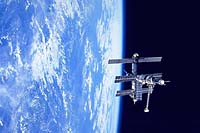
Mir Set For Evac
Moscow - May 22, 2000 � Next commercially-funded manned flight to Mir anticipated in the Fall MirCorp reports that the cosmonauts Sergei Zalyotin and Alexander Kalery will return to Earth as scheduled in mid-June, completing their mission to reactivate the Mir space station for commercial activity. The current mission began in early April and has been described by the company as the first crew sent to space without government funding, along with being the first operations on board a commercially funded space station and the first commercially sponsored spacewalk. In addition, the crew successfully began renovating the Mir, repairing critical systems, replacing batteries and finding a troublesome leak. The smooth nature of this flight led to the mission being extended from its originally planned 45 days to more than two months in space. "We have achieved all the technical milestones planned for this crew's mission onboard the station," MirCorp president Jeffrey Manber said. "Working with our colleagues in Moscow, we have proven how robust this station is, and demonstrated that the re-opening and saving of Mir captured the attention and enthusiasm of the entire world." MirCorp will spend the next several months planning its business infrastructure, and will announce new strategic partners, investors and customers in the coming months. "We showed the world a new path into space," said Manber, "now it is time to build on our success." Speaking on behalf of MirCorp's investors, Dr. Chirinjeev Kathuria said preparations already have begun for follow-on flights to Mir, with the next manned mission scheduled for the fall of this year and the third manned mission targeted for first quarter of 2001. "After demonstrating Mir's viability and completing essential renovations, we are convinced more than ever of the station's long-term usefulness as a commercial space platform," said Dr. Kathuria, who is one of the two investors in MirCorp. "The cosmonauts inspected Mir in detail and confirmed the station is in good shape. With minor continuing renovation, the station will be operational for the long term." Meanwhile, MirCorp has confirmed that it is in discussions with an Italian company to send a "Citizen Explorer" to the Mir Space Station. MirCorp President Jeffrey Manber said discussions are taking place with the Italian company Itali-Mir to send Carlo Vibert to the Mir as a guest cosmonaut. Mr. Vibert was with the European Space Agency, and already has experience with Mir training. "We are delighted to be exploring this historic mission with Itali-Mir," Manber said. "Bringing together a wide range of Italian industry, media, banks and consumer companies to support a serious mission to Mir is exactly one of our primary goals. We believe this is a good commercial model for all nations with experienced space talent." The Holland-based MirCorp was formed earlier this year to operate as a direct link between commercial users of Mir and the space station's Russian operators. MirCorp acts as a facilitator, beginning with the establishment of business conditions for Mir's use, and continuing through successful completion of a user's activity on board the station. The company signed a first-of-its kind commercial lease agreement for Mir in February with RSC Energia, the Russian space systems manufacturer that built and operates the space station. MirCorp is 60% owned by RSC Energia, while the remaining 40% held by its investors.
Email This Article Comment On This Article Related Links Space
 Satellite Launch To Boost DTH In India
 Calcutta, India (SPX) Dec 28, 2005
The successful launch Thursday of India's heaviest satellite from spaceport of Kourou in French Guyana may have boosted the country's space research efforts to yet another level, but it has also lifted the spirits of at least three Direct-To-Home televisions broadcasters, one of which has been waiting for years to launch its services in India. |
|
|

|
|
|
|
|
|
|
|
|
|
|
|
| The content herein, unless otherwise known to be public domain, are Copyright 1995-2006 - SpaceDaily.AFP and UPI Wire Stories are copyright Agence France-Presse and United Press International. ESA PortalReports are copyright European Space Agency. All NASA sourced material is public domain. Additionalcopyrights may apply in whole or part to other bona fide parties. Advertising does not imply endorsement,agreement or approval of any opinions, statements or information provided by SpaceDaily on any Web page published or hosted by SpaceDaily. Privacy Statement |