|
 |
 |
 |
 |
 |
 |
 |
 |

 |
Mine Area Clearance Vehicle Converts For Remote Operations
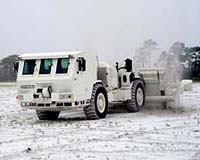
Tyndall AFB (SPX) May 09, 2006 The Headquarters Air Combat Command Civil Engineer expressed strong interest in being able to remotely employ a vehicle system and remove the man-in-the-seat during explosive ordnance clearance operations. The Hydrema 910 Mine Clearance Vehicle MCV-2 Flail System, hereafter referred to as the Mine Area Clearance Vehicle, was found to be a suitable vehicle for the task. The vehicle is a commercially available mine clearing system designed by Hydrema, a Danish commercial heavy equipment manufacturer. The vehicle is integrated into an articulated chassis so that all four wheels are in contact with the ground at all times. When being driven on roads the cab is to the front of the vehicle, however during mine clearing operations, the vehicle is driven in reverse with the cab to the rear. The vehicle is powered by two Perkins 1006-6TW six-cylinder turbocharged diesel engines. One engine is used for driving the vehicle and is coupled to a six-speed semi-automatic transmission. The second engine powers the mine clearing flails. During mine clearing operations a separate hydrostatic transmission is used, which gives a continuously variable speed and considerable force. The complete flail system can be rapidly lowered into position at the rear of the vehicle and can clear a mine path 3.5 meters wide. During mine clearing, the vehicle can be manually operated from the cab using a joystick, or it can be remotely operated through the use of a computerized fully automatic pilot steering system. When being used in the latter configuration, the operator needs only to select a number of key parameters, for example depth, on the computer monitor. The depth control of the flail and the armored deflector plate, which is positioned to the immediate rear of the rotating flail, is then fully automated using sensors. The chains rotate clockwise if mines are buried, and anti-clockwise if they are on the surface. The flail assembly consists of a rotating axle with 72 chains attached; the end of each of these is fitted with a hammer type head that weighs 0.9kg. Air Combat Command sought out the experts at the Air Force Research Laboratory's Materials and Manufacturing Directorate, Airbase Technology Division Force Protection Branch, at Tyndall Air Force Base, FL, to integrate the remote control due to the branch's recent successes with a number of robotic vehicles. The effort to install a remote control system was funded through the Headquarters Air Combat Command Civil Engineer with cost sharing from the Joint Robotic Program. The Mine Area Clearance Vehicle was delivered to the Materials and Manufacturing Directorate, where it was equipped with the remote system. The system, developed by the Advanced Robotics Team and the Joint Architecture for Unmanned Systems, is operated via radio frequency using an Materials and Manufacturing Directorate-developed joystick controller, a laptop computer, and an operator control station that houses the Ethernet and power for the system. A high-end differential global positioning system was integrated, which allows the remote operator to more accurately control the vehicle and provides positioning feedback to ensure better accuracy. The Advanced Robotic Team engineers completed the programming and code work necessary to send and receive the required signals and messages. Operating distance experiments were conducted in various environments such as wide open areas and wooded areas, to determine the best radio and antenna combination to give the operators the best possible remote capability. Once the Materials and Manufacturing Directorate was confident that they had the most robust system possible, explosive experiments were done to ensure the systems would withstand the shock of detonations with no degradation to the systems. It was found that the remote operator had remote capability up to a mile away, without any major obstructions between the antenna at the operators' end and the Mine Area Clearance Vehicle. For most operations they will probably be 2000 - 3000 feet away. The conversion took nine months. The 823rd RED HORSE Squadron at Hurlburt Field, FL., was chosen as the pilot unit for this project. This squadron usually deploys with heavy construction equipment to austere locations. The Materials and Manufacturing Directorate and Air Combat Command wanted to put the vehicle into the hands of the personnel who would be using it during regular deployment. This provides the squadron with experience operating the system. The Air Combat Command is working with Central Air Forces, the Air Component responsible for the U.S. Air Force contingent of Operation Enduring Freedom, to move the Mine Area Clearance Vehicle to Bagram Air Base, Afghanistan in the future. Community Email This Article Comment On This Article Related Links - The latest in Military Technology for the 21st century at SpaceWar.com
 Navy EOD Expanding Needs Recruits
 Norfolk VA (NNS) May 09, 2006
The Navy Explosive Ordnance Disposal (EOD) community is forming its own rating and looking for Sailors to fill an additional 80 billets, June 1. |
|
|

| The content herein, unless otherwise known to be public domain, are Copyright 1995-2006 - SpaceDaily.AFP and UPI Wire Stories are copyright Agence France-Presse and United Press International. ESA PortalReports are copyright European Space Agency. All NASA sourced material is public domain. Additionalcopyrights may apply in whole or part to other bona fide parties. Advertising does not imply endorsement,agreement or approval of any opinions, statements or information provided by SpaceDaily on any Web page published or hosted by SpaceDaily. Privacy Statement |