|
 |
 |
 |
 |
 |
 |
 |
 |

 |
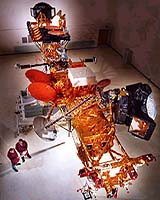
Milstar 2 Team Cut On Orbit Costs
Colorado Springs - Apr 16, 2002 A combined USAF MILSATCOM Joint Program Office/Lockheed Martin-led team has completed on-orbit testing of the second Milstar II secure communications satellite in record time and transferred full operational control of the spacecraft to the Air Force operational command. The turnover represents a major milestone as the U.S. military now has a four-satellite operational constellation -- achieving global coverage -- of the most complex military communications satellite system. Launched on Jan. 15, 2002 aboard a Titan IV B rocket, the Milstar II satellite is the Defense Department's most technologically advanced telecommunications satellite and is the second to carry the Medium Data Rate (MDR) payload. Built by Boeing Satellite Systems, El Segundo, Calif., the MDR payload has 32 channels, which can process data at speeds of 1.5 megabits per second. The spacecraft also features the Low Data Rate (LDR) payload, built by TRW Space and Electronics of Redondo Beach, Calif. TRW also supplies MDR antennas and a digital processor to Boeing. The addition of this new satellite increases the Milstar constellation's capability to provide worldwide LDR coverage for the nation's strategic forces, space warning assets and deployed operational forces. Lockheed Martin Space Systems, the prime contractor and lead systems integrator for Milstar, worked under a contract to significantly accelerate the on-orbit checkout of the satellite so it could be quickly placed into service in support of the current military operations. The team finished the on-orbit check of spacecraft systems in 64 days, roughly half the time than previous Milstar on-orbit testing. "Having a ring of four Milstar satellites around the earth is a major milestone as we now have a robust constellation that will enable the warfighter to communicate on a global basis in a secure mode without concern of enemy interference," said Maj. Gen. Dale W. Meyerrose, Director of Command Control Systems, NORAD and U.S. Space Command, and Director of Communications and Information, Air Force Space Command. "We believe this accelerated process worked well with Milstar and will serve as a template for making future MILSATCOM launches more operationally responsive and relevant," he added. The Milstar system is designed to provide the survivable communication to national leadership and also provide the military services with reliable, secure, jam-proof communications between fixed-site, mobile, maritime and portable terminals. "Milstar's 'switchboard-in-space' concept allows communications links to be established rapidly and is a revolutionary departure from current communications systems," said Christine M. Anderson, Director, MILSATCOM Joint Program Office, Space and Missile Systems Center, Los Angeles Air Force Base. "The reliability and success of this critical national program is a true testament to the dedication, skill and engineering excellence of our Milstar National Team," added Anderson. The Milstar team members, which include the U.S. Air Force, Aerospace Corp, Lockheed Martin, Boeing, TRW and Raytheon, are preparing for the final launch of a Milstar satellite, F-6, currently scheduled for launch in November 2002. Community Email This Article Comment On This Article Related Links Lockheed Martin SpaceDaily Search SpaceDaily Subscribe To SpaceDaily Express Military Space News at SpaceWar.com
 Space Group To Activate New Unit
 Colorado Springs CO (SPX) Jan 6, 2006
Air Force Reserve Command's 310th Space Group will travel deeper into the space program when it activates a new unit Jan. 7. Headquarters Reserve National Security Space Institute will be a Reserve associate unit to the National Security Space Institute in Colorado Springs, Colo. The institute is the Department of Defense's focal point for providing education about space power in joint warfighting. |
|
|

| The content herein, unless otherwise known to be public domain, are Copyright 1995-2006 - SpaceDaily.AFP and UPI Wire Stories are copyright Agence France-Presse and United Press International. ESA PortalReports are copyright European Space Agency. All NASA sourced material is public domain. Additionalcopyrights may apply in whole or part to other bona fide parties. Advertising does not imply endorsement,agreement or approval of any opinions, statements or information provided by SpaceDaily on any Web page published or hosted by SpaceDaily. Privacy Statement |