|
 |
 |
 |
 |
 |
 |
 |
 |

 |
Milky Way Is Warped, Vibrates Like A Drum, Scientists Say
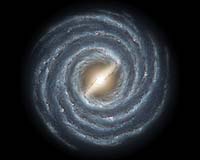
Washington (AFP) Jan 9, 2006 The most prominent of the Milky Way's satellite galaxies, called the Magellanic Clouds, appears to be interacting with the Milky Way's dark matter, creating a mysterious warp in the galactic disk, astronomers said Monday. Leo Blitz, a professor of astronomy at the University of California, Berkeley, and his colleagues have charted this warp and analyzed it in detail for the first time, based on a new galactic map of hydrogen gas emissions. The warp, seen most clearly in the thin disk of hydrogen gas permeating the galaxy, extends across the entire 200,000-light year diameter of the Milky Way, with the sun and earth sitting somewhere near the crease. The astronomers found that the atomic gas layer is vibrating like a drum, and that the vibration consists almost entirely of three notes, or modes. Astronomers previously dismissed the Magellanic Clouds - comprised of the Large and Small Magellanic Clouds - as a probable cause of the galactic warp because the galaxies' combined masses are only two percent that of the disk. This mass was thought too small to influence a massive disk equivalent to about 200 billion suns during the clouds' 1.5 billion-year orbit of the galaxy. But Martin Weinberg, a professor of astronomy at the University of Massachusetts teamed up with Blitz to create a computer model that takes into account the Milky Way's dark matter, which, though invisible, is 20 times more massive than all visible matter in the galaxy combined. The motion of the clouds through the dark matter creates a wake that enhances their gravitational influence on the disk, scientists said. When this dark matter is included, the Magellanic Clouds, in their orbit around the Milky Way, very closely reproduce the type of warp observed in the galaxy. "The model not only produces this warp in the Milky Way, but during the rotation cycle of the Magellanic Clouds around the galaxy, it looks like the Milky Way is flapping in the breeze," said Blitz, director of UC Berkeley's Radio Astronomy Laboratory. Weinberg said the simulation was "still not a perfect fit, but it has a lot of the character of the actual data." The starting point for this research was new spectral data released last summer about hydrogen's 21-centimeter emissions in the Milky Way. The survey merged a northern sky survey conducted by astronomers in the Netherlands with a southern sky survey from the Argentine Institute of Radioastronomy. The data were corrected by scientists at the Institute for Radioastronomy of the University of Bonn, Germany.
Source: Agence France-Presse Community Email This Article Comment On This Article Related Links SpaceDaily Search SpaceDaily Subscribe To SpaceDaily Express Stellar Chemistry, The Universe And All Within It
 Sloan Survey Identifies New Dwarf Galaxy Inside Milky Way
 Washington DC (SPX) Jan 10, 2006
Astronomers using the Sloan Digital Sky Survey have discovered a previously unknown cluster of stars within the Milky Way that appears to be a separate dwarf galaxy being consumed by its much larger neighbor. |
|
|

| The content herein, unless otherwise known to be public domain, are Copyright 1995-2006 - SpaceDaily.AFP and UPI Wire Stories are copyright Agence France-Presse and United Press International. ESA PortalReports are copyright European Space Agency. All NASA sourced material is public domain. Additionalcopyrights may apply in whole or part to other bona fide parties. Advertising does not imply endorsement,agreement or approval of any opinions, statements or information provided by SpaceDaily on any Web page published or hosted by SpaceDaily. Privacy Statement |