|
 |
 |
 |
 |
 |
 |
 |
 |

 |
Milestone For Australian Satellite As Space Effort Hits Wall
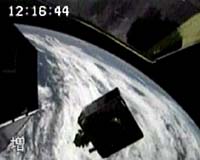
Canberra, Australia (SPX) Dec 15, 2004 The Australian research satellite FedSat has worked almost flawlessly and has circled the Earth a distance equivalent to eight hundred return trips to the Moon since it was launched two years ago. However hopes for building an Australian space program have fallen, with the Cooperative Research Centre for Satellite Systems (CRCSS), which built the satellite, expected to close its doors when Commonwealth funding expires at the end of 2005. "FedSat was the first satellite built in Australia since the late 1960s and is one of the most complex spacecraft of its size ever built" said CRCSS Chief Executive Officer Professor Andrew Parfitt. "We are tremendously proud of the achievements of our team. The highlights of the mission include being the first microsatellite to operate at the commercially cutting-edge Ka communications band: this showed that we had developed world-leading technology for transmission efficiency." "Another of the communication instruments on FedSat, our data collection and messaging system, was so good that it has been adopted for flights on Korean and Singaporean satellites." "FedSat was the first satellite to demonstrate �self-healing' computation � that means we are leading the world in error-correction to rectify computer faults caused by the harsh radiation environment of space." "Our space science program, using a sensitive instrument called a fluxgate magnetometer, has contributed to a coordinated international effort to understand and model the effects of fast-moving atomic particles on the outer shell of the Earth's atmosphere." "Eventually that will mean that satellites will work better and for longer periods: the international community will also benefit through an improved capacity to predict the impact of serious solar magnetic storms on communication satellite services and on and electric power transmission grids." "FedSat also carries a navigation payload, from which we have developed better methods for tracking spacecraft and using global satellite positioning systems for new applications." "With international competition arriving in these systems in the form of Europe's Galileo satellite navigation network, we expect that the demand for commercial services in this field will grow dramatically." "Our Centre started in 1998 when Australia had a very low level of experience in running complete space missions. We have now have over thirty doctorate and masters-level graduates of world standard in space engineering and science, and have built a competitive team drawn from our industry, university and research agency partners." "Imagine how much more we could achieve if Australia shared the belief of virtually all other developed countries, that a long-term space program is essential for economic development, education and security." Community Email This Article Comment On This Article Related Links CRCSS SpaceDaily Search SpaceDaily Subscribe To SpaceDaily Express Microsat News and Nanosat News at SpaceMart.com
 Small Satellite Solutions From Scotland
 Clyde, Scotland (SPX) Jan 12, 2006
Clyde Space are offering the growing ranks of small satellite manufacturers power subsystem solutions for their missions. Based in purpose built facilities on West of Scotland Science Park in Glasgow, Clyde Space has a range of power subsystems for missions from as little as 1W up to in excess of 2.5kW. |
|
|

| The content herein, unless otherwise known to be public domain, are Copyright 1995-2006 - SpaceDaily.AFP and UPI Wire Stories are copyright Agence France-Presse and United Press International. ESA PortalReports are copyright European Space Agency. All NASA sourced material is public domain. Additionalcopyrights may apply in whole or part to other bona fide parties. Advertising does not imply endorsement,agreement or approval of any opinions, statements or information provided by SpaceDaily on any Web page published or hosted by SpaceDaily. Privacy Statement |