Energy News  
Midsummer's Dream Galaxies

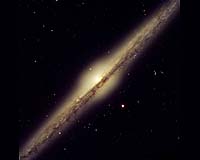
Spiral Galaxy NGC 4565. Credit: ESO.

Garching, Germany (SPX) Aug 15, 2005
How does the Galaxy in which we live look like? It is almost certain that we will never be able to send a probe out of our Milky Way to take a snapshot, in the same way as the first satellites could do to give us striking images of planet Earth.

But astronomers do not need this to imagine what our bigger home resembles. And they have a pretty good idea of it.

The Milky Way with its several hundreds of billion stars is thought to be a relatively flat disc - 100,000 light-year across - with a central bulge lying in the direction of the constellation Sagittarius (The Archer) and six spiral arms. The Milky Way has most probably also a central bar made of young, bright stars.

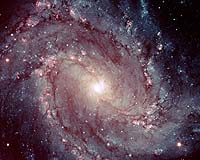
If we can't take pictures of the Milky Way, we may photograph others galaxies which astronomers think look similar to it. The two galaxies presented here are just two magnificient examples of barred spiral galaxies. One - Messier 83 - is seen face-on, and the other - NGC 4565 - appears edge-on. Together, they give us a nice idea of how the Milky Way may appear from outer space.

These images are based on data obtained with the twin FORS1 and FORS2 (FOcal Reducer and Spectrograph) instruments attached to two ESO's 8.2-m Unit Telescopes of the Very Large Telescope Array located on Cerro Paranal.

The data were extracted from the ESO Science Archive Facility, which contains approximately 50 Terabytes of scientific data and is, since April 1, 2005, open to the worldwide community.

These invaluable data have already led to the publication of more than 1000 scientific papers. They also contains many nice examples of beautiful astronomical objects which could be the theme of as many midsummer's dreams.

NGC 4565

The first galaxy pictured here is NGC 4565, which for obvious reasons is also called the Needle Galaxy. First spotted in 1785 by Uranus' discoverer, Sir William Herschel (1738-1822), this is one of the most famous example of an edge-on spiral galaxy and is located some 30 million light-years away in the constellation Coma Berenices (Berenice's Hair).

It displays a bright yellowish central bulge that juts out above most impressive dust lanes.


Community
Email This Article
Comment On This Article

Related Links
ESO
SpaceDaily
Search SpaceDaily
Subscribe To SpaceDaily Express
Stellar Chemistry, The Universe And All Within It


Memory Foam Mattress Review
Newsletters :: SpaceDaily :: SpaceWar :: TerraDaily :: Energy Daily
XML Feeds :: Space News :: Earth News :: War News :: Solar Energy News


Sloan Survey Identifies New Dwarf Galaxy Inside Milky Way
Washington DC (SPX) Jan 10, 2006
Astronomers using the Sloan Digital Sky Survey have discovered a previously unknown cluster of stars within the Milky Way that appears to be a separate dwarf galaxy being consumed by its much larger neighbor.


  • On The Horizon: A "Rinse" For Washing Machines That Dries Clothes
  • Fastnet Yacht Runs Faster With Space Technology
  • UPI Market Update: Global Oil Demand Unbalanced
  • Solar Energy Project At The Weizmann Institute Promises To Advance The Use Of Hydrogen Fuel

  • U.K. Decommissioning More Expensive Than Expected
  • The Ecological Effects Of The Chernobyl Disaster
  • Nuclear Contamination Found In Four States
  • Ancient Egypt Helps Nuclear Scientists

  • Getting To The TOPP Of Houston's Air Pollution
  • Scientists Seek Sprite Light Source


  • New Bacteria Screening Technique May Aid Food Safety
  • Farmer Becomes First Chinese Individual To Breed Seeds In Space
  • A Field Of Beams
  • Humans Trading Short-Term Food For Long-Term Environmental Losses

  • The Driving Doctor: Take Time To Observe
  • Networking: 'Smart Highways' Emerging
  • Eco-Friendly Motor Rally Sets Off From Kyoto To Celebrate Environment

  • Airbus Considers Building Manufacturing Plant In China
  • Air France Plane Hit By Lightning Before Crash: Passengers
  • Rolls-Royce Shares Rocket On Strong Profits, Dividend News
  • Imaging Technique Reduces Structural Component Failures

  • NASA plans to send new robot to Jupiter
  • Los Alamos Hopes To Lead New Era Of Nuclear Space Tranportion With Jovian Mission
  • Boeing Selects Leader for Nuclear Space Systems Program
  • Boeing-Led Team to Study Nuclear-Powered Space Systems

  • The content herein, unless otherwise known to be public domain, are Copyright 1995-2006 - SpaceDaily.AFP and UPI Wire Stories are copyright Agence France-Presse and United Press International. ESA PortalReports are copyright European Space Agency. All NASA sourced material is public domain. Additionalcopyrights may apply in whole or part to other bona fide parties. Advertising does not imply endorsement,agreement or approval of any opinions, statements or information provided by SpaceDaily on any Web page published or hosted by SpaceDaily. Privacy Statement