|
 |
 |
 |
 |
 |
 |
 |
 |

 |
Microthrusters Power NanoSats
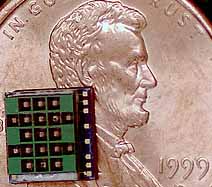
El Segundo - August 19, 1999 - The Space Shuttle Columbia (STS-93) released an important payload, the Chandra telescope, but researchers from The Aerospace Corporation are more interested in a payload the shuttle brought back -- a collection of microelectromechanical (MEMS) systems that are the subject of important tests. Tiny chip included in space shuttle experiment and shown against a penny contains 19 microthrusters, each of which acts like a rocket engine. Designed and built in a lab at The Aerospace Corporation, the thrusters could be used to orient a nanosatellite. (Photo by Pete Fuqua and Bill Hansen) The experiment represents an evolution of research into micro- and nanotechnology begun in 1992 by senior scientists Drs. Henry Helvajian and Siegfried Janson and distinguished engineer Ernie Robinson.
First Systematic Testing Though MEMS have flown on selected flights, for example on the MightySat 1 mission of Dec. 1998, systematic testing of the sort conducted aboard the Columbia and scheduled for future flights has not been done. Thus, MEMS devices cannot be considered qualified for space use, particularly not for Department of Defense purposes. Dr. David Sutton, a co-principal investigator of the experiment, said data from the 30 devices included in the experiment were downloaded onto a permanent medium within hours after shuttle touchdown on July 27. The devices had been anchored in a testbed in the Columbia's midsection during the flight.
Microgyros, Chemical Microsensors Data will be compared to see how MEMS with like characteristics performed, and how they all performed in flight compared with preflight tests in the labs. Also, MEMS data will be compared with data from sensors and instruments that the shuttle uses. For example, readings for acceleration, attitude and roll will be compared. Comparisons also will be made for readings on humidity and carbon dioxide in the shuttle atmosphere. Astronauts took air samples near the air intake of the experiment testbed, which is about the size of a computer box.
Astronauts' Help Appreciated Sutton said work on the experiment began in 1997 and that "it was ready in less than a year." It was scheduled for launch in the fall of 1998, but the mission was pushed back until July 23, 1999. Another MEMS test mission, to the International Space Station, is planned for 2001. Next would be an operational test wherein a nanosatellite with MEMS aboard would be released from the space station, possibly with a mission to examine the station's exterior.
Cannon-Launched Satellite Swarms The devices already have earned respect terrestrially. For example, they serve reliably as automotive air bag triggers, combustion control sensors, and ink-jet printer heads. MEMS are the product of microelectronic fabrication, micromolding and advanced laser processing technologies. The devices used in the Columbia experiment represent functions such as navigation and control, sensing, propulsion, computation, and thermal control that are required for spacecraft of any size.
Rocket Thrusters on a Chip The microthruster research was funded by the Defense Advanced Research Projects Agency. TRW and Caltech are partners with The Aerospace Corporation on the project. Helvajian and Janson, both of the company's Center for Microtechnology, are the leading researchers in this area.
Pioneering Research In 1998 the company established the Center for Microtechnology, headed by principal director Seymour Feuerstein, to build on pioneering work by Helvajian -- author of the just-published book, "Microengineering Aerospace Systems" -- Janson, Robinson and others. More than 30 scientists at The Aerospace Corporation are involved in this area of research. The company also has organized two international conferences on integrated micro/nanotechnology for space systems to advocate and promote its advantages. The most recent was held in April 1999 in Pasadena.
Mass-Produced Satellites The radical new way of building and using spacecraft represented by the nanosatellite concept developed at The Aerospace Corporation was formally introduced in a paper, "The Concept of 'Nanosatellite' for Revolutionary Low Cost Space Systems," presented at the International Astronautical Federation Congress in Graz, Austria, in 1993, and further described in a series of reports by Janson, Helvajian and Robinson. These reports present the details on how to design, build, power and maneuver nanosatellites. Nanosatellite technologies capable of use within five to ten years are now being explored by a number of national and international research organizations in addition to The Aerospace Corporation.
Email This Article Comment On This Article Related Links Space
 Satellite Launch To Boost DTH In India
 Calcutta, India (SPX) Dec 28, 2005
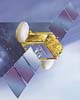
The successful launch Thursday of India's heaviest satellite from spaceport of Kourou in French Guyana may have boosted the country's space research efforts to yet another level, but it has also lifted the spirits of at least three Direct-To-Home televisions broadcasters, one of which has been waiting for years to launch its services in India.
--------------------------------------------------------- It's new. And it's downright terrific! Celestron's CPC Schmidt-Cassegrain telescope is the scope you've been waiting for! It offers new alignment technology, advanced engineering, and bold new design at a new, low price! In fact, Celestron's Professional Computerized (CPC) scope with revolutionary SkyAlign Alignment Technology redefines everything that amateur astronomers are looking for. It offers quick and simple alignment, GPS technology, unsurpassed optical quality, ease of use, advanced ergonomics, enhanced computerization and, most important, affordability. Want to view M-31 tonight? One button takes you there!
Shop for telescopes online at Telescopes.com! today!
|
|
|

|
|
|
|
|
|
|
|
|
|
|
|
| The content herein, unless otherwise known to be public domain, are Copyright 1995-2006 - SpaceDaily.AFP and UPI Wire Stories are copyright Agence France-Presse and United Press International. ESA PortalReports are copyright European Space Agency. All NASA sourced material is public domain. Additionalcopyrights may apply in whole or part to other bona fide parties. Advertising does not imply endorsement,agreement or approval of any opinions, statements or information provided by SpaceDaily on any Web page published or hosted by SpaceDaily. Privacy Statement |