|
 |
 |
 |
 |
 |
 |
 |
 |

 |
Microsoft teams up in Japan to set robotics standards
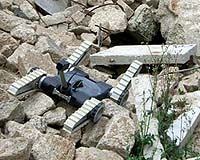
Tokyo (AFP) Sept 7, 2007 Microsoft Friday announced a tie up with Japanese humanoid maker Tmsuk in a bid to set the standard in the development of cutting-edge robots. Microsoft Corp. is the unquestioned leader in computer operating systems with Windows but the growing field of robotics relies on diverse programming platforms. The Redmond, Washington-based software giant last year launched Microsoft Robotics Studio, eying robotics as a potential expanding market of the type PCs once were. Microsoft Co. Ltd., the company's Japanese unit, said it was forming a technological alliance with Tmsuk Co. to further develop programming software. "Currently many kinds of robots are made individually based on different operating systems and not all of the newly developed technologies can be adapted to one another," said Shunichi Kajisa, the Japanese unit's chief technology officer. "We aim to commonise robotics technology by recommending researchers use our Microsoft Robotics Studio," he told a news conference. Tmsuk President Yoichi Takamoto said: "We've developed various sorts of robots with different partners, but right now we cannot adopt one technology used in robot A to robot B. "If this Microsoft software comes to be used by many developers, then technological advances in robotics will dramatically accelerate," he said. Tmsuk, a company originally focused on factory automation in the southwestern city of Kitakyushu, has developed a variety of robots for practical use as well as experimental humanoids, in cooperation with universities and other firms. One example is a disaster relief robot, which was put to use clearing rubble after a powerful earthquake hit central Japan in July. Microsoft's Kajisa said the company chose Tmsuk because of its "network of researchers in universities, as well as its past achievements in robotics." But Atsuo Takanishi, a professor at Waseda University and a leading researcher of robotics in Japan, said it remained to be seen if Microsoft would come to dominate the field. "We have to try first to see if the Microsoft software can really be used for developing robots with state-of-the-art technology," Takanishi said. "But I don't think it is very difficult to modify the existing technologies developed with other operating system -- such as Linux -- into a Microsoft version," he said. Japanese companies have increasingly focused on humanoids, seeing advanced robots as a future resource in a nation whose population is shrinking. Japan's most famous humanoid is ASIMO, which Honda Motor Co. gave birth to in 2000. ASIMO has danced and dined with dignitaries as a Japanese ambassador of sorts and has been put to use as a coffee-serving office receptionist. Community Email This Article Comment On This Article Related Links All about the robots on Earth and beyond!
 Drive-By-Wire And Human Behavior Systems Key To Virginia Tech Urban Challenge Vehicle
 Blacksburg, VA (SPX) Aug 14, 2007
Virginia Tech's entry in DARPA's Urban Challenge is moving forward to the qualifying rounds, thanks in part to a custom-designed drive-by-wire control system and unique navigation software that makes the vehicle's driving decisions almost human. "VictorTango," a team of Virginia Tech engineering and geography students, is among 36 semi-finalists selected by DARPA (Defense Advanced Research Projects Agency) to vie for the $2 million Urban Challenge prize. Qualifying rounds begin Oct. 26 at the former George Air Force Base in Victorville, Calif., and the final event will take place Nov. 3. |
|
|

| The content herein, unless otherwise known to be public domain, are Copyright 1995-2007 - SpaceDaily.AFP and UPI Wire Stories are copyright Agence France-Presse and United Press International. ESA Portal Reports are copyright European Space Agency. All NASA sourced material is public domain. Additional copyrights may apply in whole or part to other bona fide parties. Advertising does not imply endorsement,agreement or approval of any opinions, statements or information provided by SpaceDaily on any Web page published or hosted by SpaceDaily. Privacy Statement |