|
 |
 |
 |
 |
 |
 |
 |
 |

 |
Microscopic Geochemical Processes Point to Potential Problems If the Arctic Warms
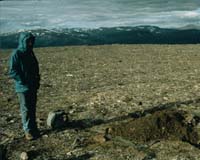
Los Angeles (SPX) Aug 10, 2006 A little-known valley in northern Sweden holds evidence that warming temperatures may lead to significant changes in nutrient availability for plants and increasing amounts of greenhouse gases, a University of Arkansas researcher and his colleagues say. "Warming temperatures could have tremendous implications for global nutrient cycling and the so-called greenhouse gases," said John C. Dixon, a geosciences professor in the J. William Fulbright College of Arts and Sciences. Dixon, Robert Darmody, a soil scientist, and Colin Thorn, a geomorphologist, both at the University of Illinois, have recently completed 15 years of work at K�rkevagge, Swedish for "Valley of the Boulders." They studied rock, soil and water samples and conducted experiments in this pristine valley in northern Sweden, based at Abisko, the northernmost year-round operating science research station in the world, run by the Swedish Academy of Sciences. K�rkevagge holds two advantages for researchers: First, it is a pristine environment, one untouched by human development. Second, the valley's high altitude allows the researchers to study geochemical processes in a cold climate considered to be a potential "hot spot" of precursors to rising global temperatures. "Climate models predict that the impacts of global warming are going to be greater at higher altitudes," Dixon said. Historically, scientists thought that chemical processes were unimportant in cold climates because, they theorized, the low temperatures would slow down reactions. However, 25 years ago Dixon showed that this was not the case. "Landscape processes are driven more by water than temperature," Dixon said. Dixon, Thorn and Darmody studied weathering, or the processes by which rocks exposed to air and water change over time. "Rocks at the surface are not stable," Dixon said. Boulders and pebbles may look the same over time to the naked eye, but microscopic changes wear at the rocks and break them apart, causing them to become rubble, then break them down further to become soil over time. This soil, given the right kind of chemistry, then can support plant life. The scientists examined the geochemistry of all of the components of the valley - the rock walls, the rock rubble and the soils - as well as minerals in the river that drains from the valley. They took soil and rock samples and looked at the chemical, physical and mineral characteristics of each. They also examined the chemistry of the water and the discharge of water into the stream to calculate the impact of the water on the changing landscape. "The chemical processes obviously act very slowly," Dixon said. To speed up the ability to understand these processes, the researchers buried limestone and granite discs in soil at different locations to get an idea of the primary environmental factors affecting rock breakdown and soil formation. They then examined them after five years and removed them after a decade. "Weathering rates are driven by variability in moisture and plant cover as it relates to soil acidity," Dixon said. "Our rock studies have given us a window back in time." They also provide a peek at possible future mechanisms for landscape change. If rising temperatures melt the permafrost in places like K�rkevagge, more liquid water will be released into the landscape through the rocks, rubble and solids in the valleys, increasing rates of weathering and changing the nutrient availability for plants and the chemical balances in the soil. The researchers' work was sponsored by grants from the National Geographic Society and the National Science Foundation. Community Email This Article Comment On This Article Related Links University of Arkansas Learn about Climate Science at TerraDaily.com Climate Science News - Modeling, Mitigation Adaptation
 Arctic Powers Account For 40 Percent Of CO2 Releases
 Fairbanks, Alaska (UPI) Aug 09, 2006
A U.S. ecology professor says arctic nations have the wealth and scientific understanding to alter the course of global climate change. "Nations that govern arctic lands account for about 40 percent of global CO2 emissions and, therefore, have a substantial capacity to reduce the rates of Arctic change," said F.S. "Terry" Chapin III of the Institute of Arctic Biology at the University of Alaska-Fairbanks. |
|
|

| The content herein, unless otherwise known to be public domain, are Copyright 1995-2006 - SpaceDaily.AFP and UPI Wire Stories are copyright Agence France-Presse and United Press International. ESA PortalReports are copyright European Space Agency. All NASA sourced material is public domain. Additionalcopyrights may apply in whole or part to other bona fide parties. Advertising does not imply endorsement,agreement or approval of any opinions, statements or information provided by SpaceDaily on any Web page published or hosted by SpaceDaily. Privacy Statement |