|
 |
 |
 |
 |
 |
 |
 |
 |

 |
Microsatellite Cluster Will Offer Space-based Radar Support For Military
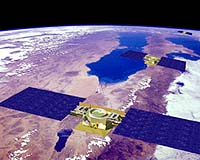
Atlanta - Nov 27, 2002 With all its awesome capabilities, radar based on satellites orbiting Earth does not yet detect moving targets on the planet. But researchers in the sensing community are working to develop a space-based radar system with such capabilities, though they face challenges in deploying antenna systems large enough to detect moving targets. A virtual antenna array, composed of multiple satellites sharing information, is one solution, and engineers at the Georgia Tech Research Institute (GTRI) have studied this approach. For the past three years, they have identified problems, developed solutions and ultimately concluded -- along with other research teams elsewhere -- that the concept has merit. Now, the U.S. Air Force Research Laboratory (AFRL) is planning a flight experiment, dubbed TechSat 21 and scheduled for launch in 2006, to demonstrate a formation of three lightweight, high-performance microsatellites. The formation will operate together as a "virtual satellite" with a single, large radar-antenna aperture. Not only will the microsatellite formation find ground- based, moving targets, it can be configured for a variety of imaging, sensing and communications missions -- something not possible with a single, large satellite. Missions include: precision geolocating; single-pass, digital terrain elevation data collection; electronic protection; single-pass, synthetic aperture radar imaging; and high data-rate, secure communications. The benefits of a microsatellite formation also include unlimited aperture size, greater launch flexibility, higher system reliability, easier system upgrade and low-cost mass production. "If this system works, it will be unique," says lead researcher Bill Melvin, a senior research engineer in GTRI's Sensors and Electromagnetic Applications Laboratory. "There is no other concept like this." While the concept has merit, TechSat 21 is still facing a number of hurdles, including properly timed wireless linking between the microsatellites, methods for calibrating system errors and reliable signal processing. A team of four GTRI engineers, including Melvin and senior research engineer Daniel Leatherwood, continues to address these issues with algorithm development and modeling and simulation studies funded by AFRL. They are also helping with plans for experiments when the trio of microsatellites is launched in 2006. AFRL researchers will gather data, including measurements to predict the system's performance using simulation code developed by GTRI engineers. Also, GTRI researchers are developing algorithms for processing that data, either in space or on the ground. "The experiments will give us an opportunity to collect data for an extended period of time, not just for one day or one week," Melvin says. TechSat 21 will provide enough data to determine the data-sharing coherence between satellites, the timing requirements for communication and target detection capability, he predicts. "Whether there is a residual military value from this experimental system will be revealed during the experiments," he adds. "Pressing needs may affect its missions." Experimental systems have been deployed in the past when military needs arose. For example, during the Gulf War, the U.S. Department of Defense deployed JointSTARS, an airborne battle management system to conduct ground surveillance and support attack operations. JointSTARS detected the famous Iraqi retreat and guided the response of military commanders in the field. "We want to automate as many processes as possible because the system will be gathering so much information," Melvin explains. "Certainly, the detection stage and switching between modes will be automated. Of course, the user could override the system." Various technological improvements are making these and other TechSat21 capabilities possible. Advances in sensor technology, antennas, satellites, electronics and digital computing, as well as lighter-weight and more durable components, are contributing. "Because of these advances, we can implement advanced algorithms and dream up new approaches that weren't even possible five or 10 years ago," Melvin says. "Technology is the driver of this project." Given that, technology has placed GTRI engineers in the driver's seat. Leveraging their extensive experience in advanced signal processing and antenna modeling, they generated results for the AFRL within a year of the program's onset, and AFRL responded by increasing GTRI's role. "We have focused on understanding the problems and developing suitable techniques to address them," Melvin explains. "Through modeling and simulation, we have determined the best possible performance for the system for ground moving target indication. So we know the concept has merit." Only physics, not technology or research effort, will limit what TechSat 21 can do, he adds. "TechSat 21 is a very non-traditional approach in radar," Melvin says. "There are a lot of doubting Thomases in the sensor community. So that makes it a challenge and makes it fun. We want to prove we can do it. Our task will be to convey to others that it can be done." Community Email This Article Comment On This Article Related Links Georgia Institute of Technology SpaceDaily Search SpaceDaily Subscribe To SpaceDaily Express Military Space News at SpaceWar.com
 Space Group To Activate New Unit
 Colorado Springs CO (SPX) Jan 6, 2006
Air Force Reserve Command's 310th Space Group will travel deeper into the space program when it activates a new unit Jan. 7. Headquarters Reserve National Security Space Institute will be a Reserve associate unit to the National Security Space Institute in Colorado Springs, Colo. The institute is the Department of Defense's focal point for providing education about space power in joint warfighting. |
|
|

| The content herein, unless otherwise known to be public domain, are Copyright 1995-2006 - SpaceDaily.AFP and UPI Wire Stories are copyright Agence France-Presse and United Press International. ESA PortalReports are copyright European Space Agency. All NASA sourced material is public domain. Additionalcopyrights may apply in whole or part to other bona fide parties. Advertising does not imply endorsement,agreement or approval of any opinions, statements or information provided by SpaceDaily on any Web page published or hosted by SpaceDaily. Privacy Statement |