|
 |
 |
 |
 |
 |
 |
 |
 |

 |
Microsat Systems Surpasses Expectations For Air Force Techsat 21
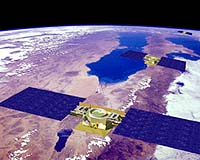
Denver - Apr 30, 2003 MicroSat Systems Inc. (MSI) recently completed rigorous structural and dynamics testing of the TechSat 21 satellite bus, setting a new industry standard for rapid development, test and integration. "Building high-performance small spacecraft quicker and for less money does not have to come at the expense of quality," said John Roth, president, MicroSat Systems. These tests confirm the company's ability to accurately predict the response of the spacecraft structure-to-launch environments using streamlined engineering processes. "We can trace every step, validate every test and document every requirement efficiently and completely. As we move forward with the processing of satellites we will be able to incorporate today's testing into an efficient and rapid design-to-flight service for our customers," Roth added. Dynamics testing of the TechSat 21 structural engineering development unit (EDU) progressed through successful testing of both the X and Y axes through the severe launch vehicle environments of random vibration, sine vibration, and sine burst testing. TechSat 21 has been designed for the challenging Delta IV Evolved Expendable Launch Vehicle (EELV) secondary payload adapter (ESPA) launch environment. MSI engineers and technicians are in the process of rotating the EDU to orient the Z axis into alignment on the shaker machine for the next round of testing at Kirtland Air Force Base, Albuquerque, NM. After Z axis testing engineers will reconfigure the EDU payload mass simulator to represent the TechSat 21 radar payload and repeat the testing. MSI also successfully completed interface verification testing of the attitude control system's torque rods, demonstrating the company's ability to complete multiple unplanned scenarios, gather data that was not pre-planned and trouble shoot minor problems in real time. MicroSat Systems offers rapid response to unique customer requirements by providing short development cycle times at low cost. MicroSat Systems is a small Colorado-based company that designs, develops, integrates, tests and operates high-performance satellites and spacecraft subsystems, including lightweight thin film solar arrays and multi-functional composite structures. Community Email This Article Comment On This Article Related Links MicroSat Systems SpaceDaily Search SpaceDaily Subscribe To SpaceDaily Express Microsat News and Nanosat News at SpaceMart.com
 Small Satellite Solutions From Scotland
 Clyde, Scotland (SPX) Jan 12, 2006
Clyde Space are offering the growing ranks of small satellite manufacturers power subsystem solutions for their missions. Based in purpose built facilities on West of Scotland Science Park in Glasgow, Clyde Space has a range of power subsystems for missions from as little as 1W up to in excess of 2.5kW. |
|
|

| The content herein, unless otherwise known to be public domain, are Copyright 1995-2006 - SpaceDaily.AFP and UPI Wire Stories are copyright Agence France-Presse and United Press International. ESA PortalReports are copyright European Space Agency. All NASA sourced material is public domain. Additionalcopyrights may apply in whole or part to other bona fide parties. Advertising does not imply endorsement,agreement or approval of any opinions, statements or information provided by SpaceDaily on any Web page published or hosted by SpaceDaily. Privacy Statement |