|
 |
 |
 |
 |
 |
 |
 |
 |

 |
Microorganism Isolated In Space
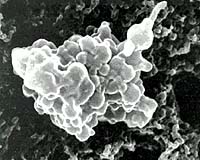
Cardiff - Dec 18, 2002 How far up into the sky does the biosphere extend? Do microorganisms exist at heights of 40 km and in what quantity? To answer these questions several research institutes in India collaborated on a path-breaking project to send balloon-borne sterile "cryosamplers" into the stratosphere. The programme was led by cosmologist Professor Jayant Narlikar, Director of the Inter University Centre for Astronomy and Astrophysics in Pune, with scientists at the Indian Space Research Organisation and the Tata Institute of Fundamental Studies contributing their various expertise. Large volumes of air from the stratosphere at heights ranging from 20 to 41km were collected on 21 January 2001. The programme of analysis of samples in the UK was organised by Professor Chandra Wickramasinghe of Cardiff University, co-proponent with the late Sir Fred Hoyle of the modern theory of panspermia. This theory states that the Earth was seeded in the past, and is still being seeded, with microorganisms from comets. Last year a team of biologists at Cardiff University's School of Biosciences reported evidence of viable bacteria in air samples at 41km in such quantity that implied a world-wide settling rate of one tonne of bacterial material per day. Although living bacteria were seen they could not be grown in the laboratory. Dr Milton Wainwright of Sheffield University's Department of Molecular Biology and Biotechnology, was asked to apply his skills to growing the organisms. Dr Wainwright isolated a fungus and two bacteria from one of the space derived samples collected at 41km. The presence of bacteria in these samples was then independently confirmed. These results are published in this month's issue of a prestigious microbiology journal FEMS Letters (Wainwright et al, 2002), published by Elsevier. The isolated organisms are very similar to known terrestrial varieties. There are however notable differences in their detailed properties, possibly pointing to a different origin. Furthermore, it should be stressed that these microorganisms are not common laboratory contaminants. Dr Wainwright says, however, "Contamination is always a possibility in such studies but the "internal logic" of the findings points strongly to the organisms being isolated in space, at a height of 41km. "Of course the results would have been more readily accepted and lauded by critics had we isolated novel organisms, or ones with NASA written on them! However, we can only report what we have found in good faith". The new work of Wainwright et al is consistent with the ideas of Hoyle and Wickramasinghe that in fact predict the continuing input onto the Earth of "modern" organisms. In recent years and months there has been a growing body of evidence that can be interpreted as support for the theory of panspermia - e.g. the space survival attributes and general space hardiness of bacteria. Community Email This Article Comment On This Article Related Links "The detection of living cells in stratospheric samples" Cardiff Centre for Astrobiology SpaceDaily Search SpaceDaily Subscribe To SpaceDaily Express Life Beyond Earth Lands Beyond Beyond - extra solar planets - news and science
 SETI Sets Its Sights On M Dwarfs
 Moffett Field CA (SPX) Nov 18, 2005
Scientists have been searching actively for signs of intelligent extraterrestrial civilizations for nearly half a century. Their main approach has been to point radio telescopes toward target stars and to "listen" for electronic transmissions from other worlds. |
|
|

| The content herein, unless otherwise known to be public domain, are Copyright 1995-2006 - SpaceDaily.AFP and UPI Wire Stories are copyright Agence France-Presse and United Press International. ESA PortalReports are copyright European Space Agency. All NASA sourced material is public domain. Additionalcopyrights may apply in whole or part to other bona fide parties. Advertising does not imply endorsement,agreement or approval of any opinions, statements or information provided by SpaceDaily on any Web page published or hosted by SpaceDaily. Privacy Statement |