|
 |
 |
 |
 |
 |
 |
 |
 |

 |
Microbes That Turn Mud Into Electricity
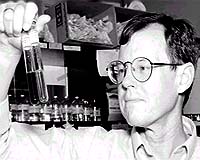
Amherst � Jan 22, 2002 Will soldiers someday wear vests containing microbes that signal contact with biological weapons? Could un-manned submarines or underwater sensing devices run on microbe-power? Research conducted by University of Massachusetts microbiologists and reported in this week�s issue of the journal Science concludes that certain microorganisms can transform organic matter commonly found at the bottom of the ocean into electrical energy. Aside from raising the possibility that microbes someday could be used to produce power in subsurface settings, the findings have implications for many industrial and military applications, according to Derek R. Lovley, UMass microbiologist and team leader. An understanding of how microbes generate and use electrical energy may also prompt the development of new technologies to decontaminate polluted water and sediment containing organic materials, including petroleum and other aromatic hydrocarbons, he says. In the Science article, Lovley explains how the team used water and sediment from Boston Harbor, a collection of mason jars, ordinary electrical wiring, and sterile graphite electrodes to determine the science behind the mechanics of a simple, sediment battery. The researchers added a layer of common mud to water in the jars, put one graphite electrode in the mud, another in overlying water. The resulting electrical current was strong enough to activate a lightbulb, or a simple computer. �Even using a primitive electrode made from graphite,� Lovley said, �it is possible to produce enough current to power basic electronic marine instruments.� Through more refined experiments, Lovley�s group found that a family of energy-harvesting microorganisms, commonly referred to as Geobacters, were key to the production of the electrical current. Whereas most life forms, including humans, get their energy by oxidizing organic compounds with oxygen, Geobacters can grow in environments lacking oxygen by using the iron naturally present in soil, in place of oxygen. This new research demonstrates that Geobacters can also substitute an unnatural substance, such as an electrode, for the iron, according to Lovley. A large number of a Geobacter species known as Desulfuromonas acetoxidans (D. acetoxidans) were found on the anode end of the primitive batteries. When the researchers destroyed the D. acetoxidans in the sediment, the current stopped. �In the mud, a community of microorganisms cooperates to break down larger, more complex organic compounds to acetate. Geobacters then transfer the electrons from the acetate to the electrode generating the electrical energy,� he said. Lovley�s group also has found that some Geobacters can convert toxic organic compounds, such as toluene, to electricity. Lovley says this suggests that some Geobacters can be used to harvest energy from waste matter, or can be included in technology used to clean up subsurface environments contaminated by organic matter, especially petroleum. Earlier studies had shown bacteria could produce electricity under artificial conditions in which special chemicals were added, but the UMass study was the first to prove that the nearly ubiquitous microbes living in a typical marine environment could produce electricity under the conditions naturally found in that environment. �Once we know more about the genome of Geobacters, we will be able to manipulate these organisms to make them receptive to a variety of organic or inorganic contaminants. Theoretically, when they begin to degrade the contaminant, they will throw electrons on an electrode, and that could set off a light, a sound or some other form of signal,� Lovley said. �An understanding of how this phenomenon operates has a number of extremely timely applications, especially in developing technologies to recognize toxins and organic contaminants.� Lovley cites, for example, the potential for using such technology to develop military equipment that could alert soldiers to the presence of toxins or biological warfare agents in the immediate environment. The Office of Naval Research funded this study. The research team included Daniel R. Bond and Dawn E. Holmes from UMass, and Leonard M. Tender of the Naval Research Laboratories. Community Email This Article Comment On This Article Related Links Microbiology at Massachusetts SpaceDaily Search SpaceDaily Subscribe To SpaceDaily Express Space Technology News - Applications and Research
 Industry Team Achieve New Communications Technology With AESA Radars
 Baltimore MD (SPX) Jan 12, 2006
A team comprised of three leading US aerospace and defense contractors has demonstrated an innovative technological use of active electronically scanned array (AESA) radars for high-bandwidth communications. |
|
|

| The content herein, unless otherwise known to be public domain, are Copyright 1995-2006 - SpaceDaily.AFP and UPI Wire Stories are copyright Agence France-Presse and United Press International. ESA PortalReports are copyright European Space Agency. All NASA sourced material is public domain. Additionalcopyrights may apply in whole or part to other bona fide parties. Advertising does not imply endorsement,agreement or approval of any opinions, statements or information provided by SpaceDaily on any Web page published or hosted by SpaceDaily. Privacy Statement |