|
 |
 |
 |
 |
 |
 |
 |
 |

 |
Mexico Readies World's Largest Radio Telescope
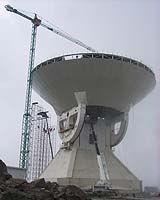
Atzizintla (AFP) Mexico, Nov 21, 2006 Perched at 4,600 meters (15,000 feet) on a cold, spent volcano, the Large Millimeter Telescope (LMT) will use radio waves to look into the dawn of the universe when it begins a two-year testing period on Wednesday. At 2,000 tonnes and 115 million dollars, its 50-meter (164-yard) dish -- the world's largest -- is the result of a joint effort of Mexico's National Institute of Astrophysics, Optics and Electronics (INAOE) and the US University of Massachusetts. "This telescope is capable of observing conditions prevalent when the first stars and galaxies were formed 13,400 billion years ago," INAOE astrophysicist and project manager Emanuel Mendez told AFP. Eight years in the making, the German-designed LMT will be the most precise radio telescope of its kind in the world and will be used to study the composition of comets, the atmospheres of planets beyond our solar system, and the origins of the universe. "Microwave astronomy is still in its infancy and promises to unveil facinating secrets," Mendez said. "Short millimeter wavelengths will give us precise measurements of speed, temperature, density, magnetic field and physical composition of our targets," he added. The steel-and-cement structure will be officially inaugurated on Wednesday, after which the telescope will be put through rigorous testing before it is deemed fully operational in 2008. Its base on the Sierra Negra volcano, 350 kilometers (217 miles) southeast of Mexico City, ensures near optimal conditions for its operation: very low humidity and a vantage point giving it an excellent view of both southern and northern skies. "Microwaves crave water vapor, so if we want to see faint, distant objects, it's imperative the surrounding atmosphere be as dry as possible," Mendez said. The only problem the LMT has to contend with are the very high winds buffeting the mountain. "It was designed to withstand wind speeds of up to 200 kilometers (1,240 miles) per hour," he added. The INAOE and the University of Massachusetts will share the annual cost of running the LMT, estimated at 4.5 million dollars.
Source: Agence France-Presse Community Email This Article Comment On This Article Related Links All about the technology of space and more Space Telescope News and Technology at Skynightly.com
 Russia Wants To Build Telescope Superior To Hubble
 Moscow (RIA Novosti) Nov 22, 2006
Russia will build a deep space exploration telescope that will outstrip the U.S.-made Hubble Space Telescope, a Russian astronomer said Tuesday. Hubble, orbited in 1990, has been the most successful and expensive project in astrophysics, costing over $6 billion. |
|
|

| The content herein, unless otherwise known to be public domain, are Copyright 1995-2006 - SpaceDaily.AFP and UPI Wire Stories are copyright Agence France-Presse and United Press International. ESA PortalReports are copyright European Space Agency. All NASA sourced material is public domain. Additionalcopyrights may apply in whole or part to other bona fide parties. Advertising does not imply endorsement,agreement or approval of any opinions, statements or information provided by SpaceDaily on any Web page published or hosted by SpaceDaily. Privacy Statement |