|
 |
 |
 |
 |
 |
 |
 |
 |

 |
Methane Storage Material Exceeds US DoE Goals
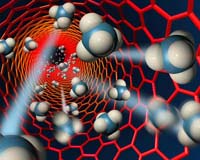
Oxford OH (SPX) Jan 25, 2008 Researchers in the laboratory of Miami University chemist Hong-Cai Zhou, associate professor of chemistry and biochemistry, report development of a microporous material with the highest methane storage capacity ever measured. It can hold almost one-third more methane than the U.S. Department of Energy's (DOE) target level for methane-powered cars, they report in a new study. Methane stands out among various alternative fuels when its profusion and availability are considered. However, the lack of an effective, economic and safe on-board storage system is one of the major technical barriers preventing methane-driven automobiles from competing with the traditional ones, say the study authors. In the past decade, a new type of highly porous crystalline materials called metal-organic frameworks (MOFs) have emerged as promising storage materials due to their high surface area, tunable pore size and modifiable surface. Several MOFs have been screened for methane storage but none have reached DOE target levels considered practical for fuel storage applications, the scientists say. Their paper, published in the January 23 issue of the Journal of the American Chemical Society, describes the synthesis and structural characterization of the metal-organic framework (MOF) designated PCN-14, based on a pre-designed anthracene derivative. (PCN stands for porous coordination network). PCN-14 contains nanoscopic cages suitable for methane storage, with a high Langmuir surface area of more than 2000 square meters per gram (m2/g). The methane uptake (absolute methane-adsorption capacity) of PCN-14 is 230 v/v - 28 percent higher than the DOE target of 180 v/v for methane and the highest ever measured. Authors of "Metal-Organic Framework from an Anthracene Derivative Containing Nanoscopic Cages Exhibiting High Methane Uptake" include Shengqian Ma, doctoral candidate (first author); Daofeng Sun, former postdoctoral research associate; Jason M. Simmons, National Institute of Standards and Technology and the University of Pennsylvania; Christopher D. Collier, senior biochemistry major; Daqiang Yuan, postdoctoral research associate and Hong-Cai Zhou. Community Email This Article Comment On This Article Related Links Miami University Space Technology News - Applications and Research
 Researchers Develop Darkest Manmade Material
 Troy NY (SPX) Jan 23, 2008
Researchers at Rensselaer Polytechnic Institute and Rice University have created the darkest material ever made by man. The material, a thin coating comprised of low-density arrays of loosely vertically-aligned carbon nanotubes, absorbs more than 99.9 percent of light and one day could be used to boost the effectiveness and efficiency of solar energy conversion, infrared sensors, and other devices. |
|
|

| The content herein, unless otherwise known to be public domain, are Copyright 1995-2007 - SpaceDaily.AFP and UPI Wire Stories are copyright Agence France-Presse and United Press International. ESA Portal Reports are copyright European Space Agency. All NASA sourced material is public domain. Additional copyrights may apply in whole or part to other bona fide parties. Advertising does not imply endorsement,agreement or approval of any opinions, statements or information provided by SpaceDaily on any Web page published or hosted by SpaceDaily. Privacy Statement |