|
 |
 |
 |
 |
 |
 |
 |
 |

 |
Methane Found On Saturn Plays Crucial Role In Planet Formation
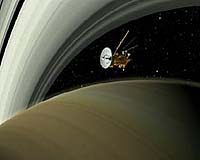
Livermore CA (SPX) Jan 06, 2005 Using an infrared spectrometer on the Cassini-Huygens Spacecraft, researchers have measured the temperature, winds and chemical composition of Saturn, its rings and one of its moons, Phoebe. The data appears in the Dec. 23 edition of "Science Express" and in the Dec. 24 print edition of Science. Edward Wishnow of Lawrence Livermore National Laboratory participated in the research by measuring the spectrum of methane in the laboratory at temperatures and densities similar to the planet's�about 90 Kelvin (-297 degrees F) and one atmosphere of pressure. Methane (CH4), the principal component of natural gas, is the main indicator of carbon on Saturn and Jupiter, and it plays a crucial role in the planet's atmospheric chemistry and history of formation. The Cassini Composite Infrared Spectrometer (CIRS) is an infrared instrument that measures the intensity of far-infrared radiation, light with wavelengths between those of radar and near-infrared light. These wavelengths are associated with radiation emission by the constituent gases of the planet's atmosphere or the ices and/or rocks that compose the rings and the moon Phoebe. "Though we've known for years that the atmospheres of the giant planets are mainly made up of hydrogen and helium, using these instruments, we were able to measure the methane content with much greater precision than previous space missions," said Wishnow, who works in LLNL's Physics and Advanced Technologies Directorate. The methane measurement shows that carbon is enriched on Saturn by seven times the amount found in the sun and two times the amount found on Jupiter, which is consistent with the rocky core hypothesis of giant planet formation. In this model, Jupiter and Saturn began formation by accreting cores of about 10-12 times the size of Earth's mass of heavy elements, which, in turn, attracts the surrounding nebular gas in solar proportions. Community Email This Article Comment On This Article Related Links Cassini-Huygens at JPL Cassini Imaging Team Lawrence Livermore National Laboratory SpaceDaily Search SpaceDaily Subscribe To SpaceDaily Express Explore The Ring World of Saturn and her moons Jupiter and its Moons The million outer planets of a star called Sol News Flash at Mercury
 Cassini Images Halo Around Titanic Moon Off Saturn
 Pasadena CA (SPX) Dec 27, 2005
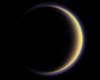
With its thick, distended atmosphere, Titan's orange globe shines softly, encircled by a thin halo of purple light-scattering haze. |
|
|

| The content herein, unless otherwise known to be public domain, are Copyright 1995-2006 - SpaceDaily.AFP and UPI Wire Stories are copyright Agence France-Presse and United Press International. ESA PortalReports are copyright European Space Agency. All NASA sourced material is public domain. Additionalcopyrights may apply in whole or part to other bona fide parties. Advertising does not imply endorsement,agreement or approval of any opinions, statements or information provided by SpaceDaily on any Web page published or hosted by SpaceDaily. Privacy Statement |